Bakokoto v Maseiman
JUDGMENT OF THE COURT
Introduction
1. This is an appeal against a decision of the Efate Island Court (“EIC”) of 31 March 2009. The Court found that there are three main customary lands and two overlapping lands: Etefkau/Ewornagir (brown on the map), Eurakot-Eleo (pink on the map), Etomou (blue on the map); and two overlapping lands, and a small part of Epang-Tue (green on the map), and:
The overlap of Tefkau/Ewornagir started at ENVET along the seashore reaching Origin Gas crossed the road to Punjas warehouse, then up to the Nabanga tree near the house of Pat Bochenskl, along the cliff towards the house of Thessa Fowler, then across up to Efare Baikor (Digicel tower) along the line of the cliff of Eleo Erasa to the corner of the road to Elluk hill, then down to the concrete wall at “Le Lagon”, at the place of Plesaur/Pleibong The original claimant wrote EMETPER on his map.
The ancestral custom boundaries of ELEO-EURAKOT started at Origin Gas along the shore going towards the nabanga at Star wharf leading straight to a series of cliffs up to the water tank, passed behind the other cliff beyond Lakowale on towards E-Tukor on the Epang-Twei side.
Then they started again at E-Tukor along the shore back past Emis point, including Eslaorsfir, Eselpako, Elkao, Esnar, Eparas, Eluk beyond “Le Lagon Hotel" on to EMETPER (Plesaur/Plebong).
They ran parallel to the boundaries of Etefkau/Ewornagir at Emetper, then up to the Elluk hill road, first corner then back towards Erfale Baikor down close to the Fowler house then onto near the Bochenski house and down to Origin Gas.
The ancestral custom boundaries of ETTOOMOO started at the nabanga before Star Wharf, ran parallel to the boundary of Eurakot/Eleo, past Loukwale, down to the coast along the cliff, passing behind Pango village on to E-Tukor.
From E-Tukor they ran along another series of cliffs, past Mumu and Kotkot through to Dream Cove, along the sea past the Etumou hill with the Worauloa Point continuing along the seashore past the main wharf then back to the Nabanga tree at the Star Wharf.
The overlap of Epangtwuei started at the end of Dream Cove to reach Efarfer, across the bush to E-Tukor, then along a series of cliffs then back down to the end of Dream Cove.
2. The EIC then made declarations of custom ownership in relation to various customary lands. We set out the declarations made at paragraph 17.
Background
3. The original claimant was Family Toktok Kaluatman. (“the original claimant”) Their claim is dated 20 October 1995. The background to the claim is set out in a letter the original claimant gave to the EIC on 19 October 1995. [1] The relevant parts of the letter are:
Subject: Eluck Sub-division Title 224 mo 1288
(Eleo-Eurakot Pango)
Follem strick-off blong interim injunction true long Magistrats Court Mr Vincent Lunabek long 2falla title ia: Title 224 mo 1288. Familly Toktok Kaluatman I wantem lodgem claim blong hem long 2falla title ia ling Efate Island Court.
(Letta ia mifalla headship mo members mifalla I raitem long 10.30am after long interim injunction Court long this morning.)
The English translation is:
Subject: Eluck Subdivision Title 224 and 1288
Following the strike-off of the Interim Injunction through the Magistrate Court, Mr Vincent Lunabek, regarding these 2 titles, Title 224 and 1288, Family Toktok Kaluatman want to lodge its claim over these two titles before the Efate Island Court.
(We the Headship and members have written this letter at 10.30am following the Interim Injunction in Court this morning.)
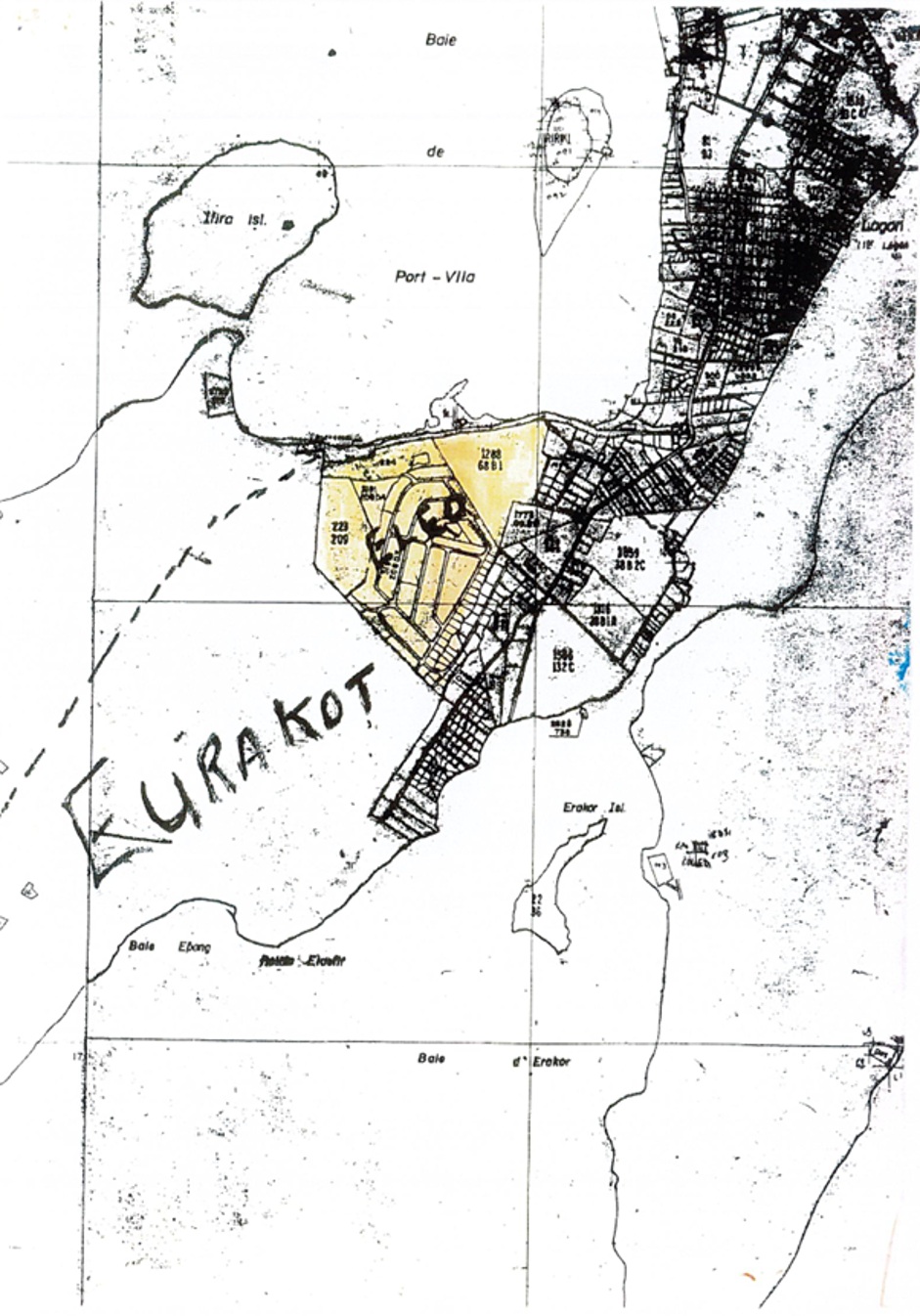
4. In the claim, the family said the claim was regarding Eleo (Eurakot) land at the Elluk subdivision in Pango. The family did not identify the boundaries claimed. Instead, they said they were claiming condominium titles 244, 1288 and other titles. They attached a map to their claim and said they were claiming the land shaded yellow on the map, as set out below:
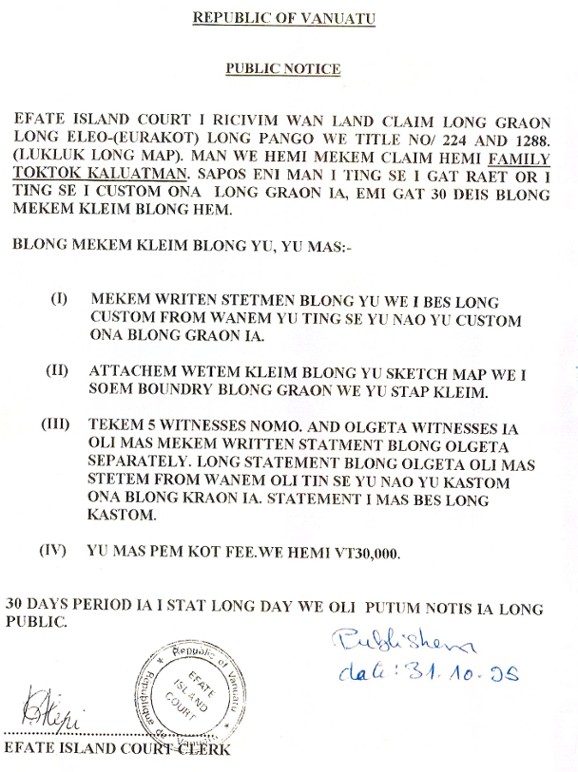
5. On 31 October 1995, the EIC publicly notified the claim. The public notice said the claim related to title number 224 and 1288 and the map with the yellow shaded area claimed was attached to the public notice. The public notice said:
6. There were 19 counterclaimants. The counterclaimants were from Pango, Erakor and Ifira. The proceedings in the Island Court progressed very slowly. It was not until 24 May 2007, some 12 years after the original claim was filed, that the EIC directed Family Tokotok Kaluatman to provide the boundaries of the Eleo-Eurakot custom land claimed in 1995, a family tree and custom history relating to the land claimed. The claimant did not comply. On 14 September 2007, the EIC made an order that Family Toktok was to attend a hearing to show cause why they had not complied with the orders made on 24 May 2007. The Court raised the possibility the claim would be struck out.
7. Because of concerns that the claim could be struck out, four of the counterclaimants withdrew their claims and merged with the original claimant. These were Family Marik Matokoale, Family Kalotiti Kalotrip, Family Kalsa Lel and Naflak Natongrau. From the records, the counterclaims of Family Kalotiti Kalotrip and Family Naflak Nawi Natongrau were discontinued, without objection from any other party. The judgment also records that the other two counterclaimants had joined the original claimant. [3] That led to the original claimant being renamed Family Kalpram Cooke Maseiman, and the submission of a new sketch map, connected family trees and their custom history.
8. In 2007, Family Kalpram Cooke Maseiman, the first respondent in this appeal, filed a second map with a boundary that appears to extend beyond their original 1995 claim. (“the second map”) This map was included in the document dated 2 November 2007 [4]. This was in response to a direction that all parties were to submit their written histories, family trees and sketch maps at least two weeks before the trial date. [5] In submissions to us, it was confirmed that the 2007 map was a “new” boundary map. [6] That it was a new boundary map is self-evident when compared with the original map filed in 1995. The custom land claimed in 2007 was significantly greater than the original claim. The second map is set out below:
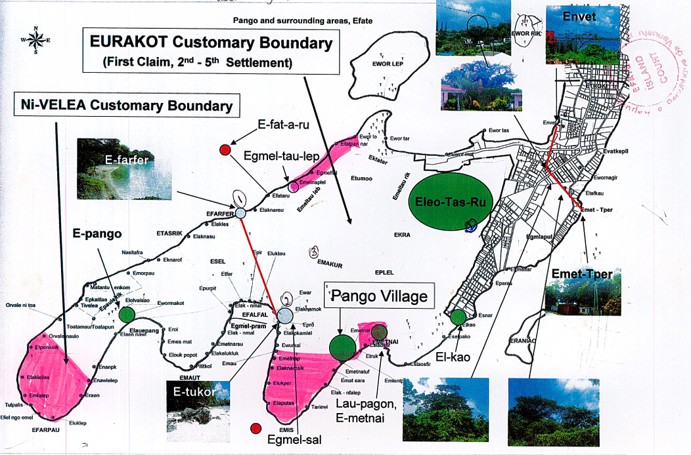
9. As we explain later in the judgment, there is no evidence the second map and boundary detailed in the document dated 2 November 2007 were advertised. The counterclaimants also filed sketch maps. Some of these maps went beyond Family Kalpram Cooke Maseiman’s original claim and were not advertised.
Judgment under appeal
10. The EIC said it was considering a claim for Eleo/Eurakot custom land in South Efate. The Court set out the custom boundaries of the land and included a map which showed the boundaries of the land. The map included in the judgment, and upon which the declarations of custom ownership were made, is not the map advertised in 1995. The EIC based its declarations on the second map submitted by the claimant in November 2007. The map and boundaries as detailed in the judgment are set out below:
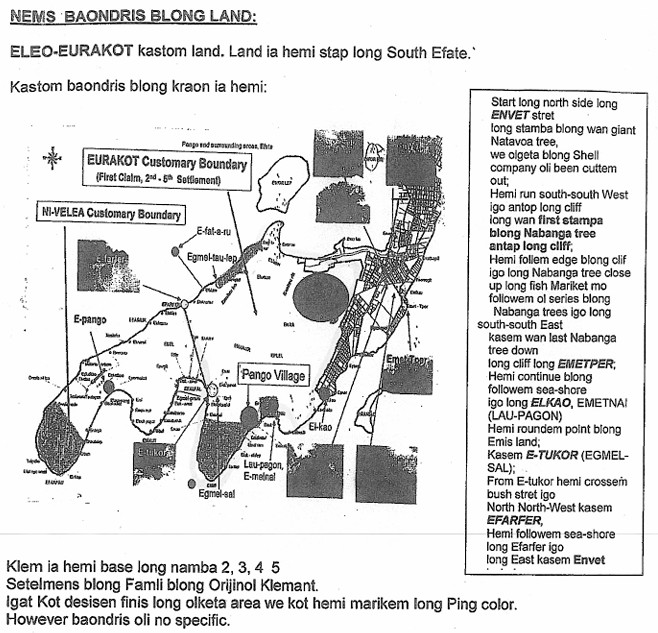
11. The EIC said the boundaries claimed started on the north side at Envet and went in a south-south-easterly direction to Emetper. From Emetper, the boundary continued along the seashore, around the point of Emis land to E-Tukor. From E-Tukor, the boundary crossed the bus in a north-north-westerly direction to Efarer. The boundary then followed the seashore at Efarer in an easterly direction back to Envet.
12. The Court walked the boundaries over a period of days, noting the disputed boundaries were very extensive. The Court visited 66 custom sites, starting from Dream Cove to Paradise Cove, and amongst other sites, Pango village, Breakas resort, down to Le Lagon resort, up to the top of Elluk, down to Origin Gas, the Star Wharf and the Main Wharf, ending at Worolua point.
13. In the judgment, the EIC did not address the difference between the map filed with the original claim in 1995 and the map recorded in the judgment. Nor did the Court address why the claimed boundaries were as detailed in the judgment, and not the original claim. Further, the Court made no reference to whether or not the second map and boundaries had been advertised.
14. The EIC set out the applicable custom in Efate, noting that the patrilineal bloodline system applies in South Efate, subject to certain exceptions to the general rule.
15. The Court went on to consider the competing claims. The Court recorded that four counterclaimants from the Pango group had joined the original claimant. [7] The Court also recorded that two of the counterclaimants had asked to discontinue their claim, and as there was no objection, granted the discontinuances. The Court also recorded that there was also a merger of Family Sakia Kalpoi and Family Tongala Kalpuki. This party was Family Marik Kalontan. [8]
16. The EIC heard evidence from the parties over a 3 month period and said that the land dispute involved 3 major villages in South Efate, being Pango, Erakor and Ifira. As such, the Court divided the parties into 3 categories; Pango group, Erakor group, and Ifira group.
17. After considering the competing claims, the EIC made the following declarations of custom ownership:
a. Eleo/Eurakot land belongs to the original claimant and descendants of Kalpram Cooke Maseiman (pink on the map)
b. Matulep Serah (Family Kalpram Tuekot) inherited her father’s rights. She was declared custom owner of land in Pango, which should be around Ekpeliu Emakur. It is included in the land “Etu Maau” or Etoomou. (blue on the map)
c. Family Able Naar and descendants were declared custom owners of overlying land. This was described as the overlap between Epangtuei and Etu Maanu at Efalfal (green on the map).
d. John Kalwat was declared custom owner of land starting down at the sea directly at Keltao extending to Emetper (Plesaur/Plebong). Up to the top of the second cliff, running along the ridge of the second plateau (the foot of the hill at Amalfi Court), then back down to Keltao.
e. That the land known as Etefkau/Ewornagir belonged to the descendants of the Erakor chiefly line (Family Wimak).
f. Pastor Russel Bakokoto held perpetual ownership over Ettoomou I and Etoomoo II. His rights covered only those lands where there is already a lease title. [9]
Legal principles relevant to land appeals
18. Articles 73 and 74 of the Constitution of the Republic of Vanuatu (“the Constitution”) states:
“73. Land belongs to custom owners
All land in the Republic of Vanuatu belongs to the indigenous custom owners and their descendants.
74. Basis of ownership and use
The rules of custom shall form the basis of ownership and use of land in the Republic of Vanuatu.”
19. At the time of the EIC hearing, the Island Court was mandated to deal with disputes over custom ownership of land. Section 10 of the Island Courts Act [CAP 167] (the Act) sets out its jurisdiction to apply customary law:
“10. Application of customary law
Subject to the provisions of this Act an island court shall administer the customary law prevailing within the territorial jurisdiction of the court so far as the same is not in conflict with any written law and is not contrary to justice, morality and good order.”
20. The appeals were filed pursuant to s 22 of the Island Courts Act. Pursuant to s 22, the Court shall:
a. Appoint two assessors knowledgeable in custom to sit with the Court.
b. Consider the records (if any) relevant to the decision and receive such evidence (if any) and make such inquiries (if any) as it thinks fit.
21. Section 23 of the Island Courts Act sets out the Court’s power on appeal:
“23. Power of court on appeal
The court in the exercise of appellate jurisdiction in any cause or matter under section 22 of this Act may –
(a) make any such order or pass any such sentence as the island court could have made or passed in such cause or matter;
(b) order that any such cause or matter be reheard before the same court or before any other island court.”
22. As was held in Manlaewia v Maripopongi [2015] VUSC 119, an appeal under s 22 of the Island Courts Act proceeds by way of rehearing, based on the Island Court records, supplemented by further evidence and inquiries the Supreme Court may in its discretion permit “as it thinks fit”.
23. In Nov v Family Tangis [10], the Court of Appeal recently said in relation to a land appeal:
29……… Under Section 22(1) (a) of the Island Courts Act, the Supreme Court is the Court hearing the appeal in all matters concerning disputes as to ownership of land. Under section 22(3), the Court hearing the appeal shall consider the Island Court records (if any) relevant to the decision, receive such evidence (if any) and make such inquiries (if any) as it thinks fit. Section 22(3) of the Island Courts Act is not a limited jurisdiction. It has to be interpreted and applied widely.
Delays
24. The EIC judgment was delivered on 31 March 2009. Appeals were filed within the time periods set out in s 22 of the Island Courts Act [CAP 167]. As the Court has previously observed, the delays in hearing the appeal are inexplicable and extraordinary. Since I was assigned the case management responsibilities for this land appeal, [11] there has been active case management to ensure the appeal could be heard. [12]
25. The appeal was to be heard on 16 September 2025. Mr S Hakwa, then counsel for the fifth appellant was on medical leave so the hearing was adjourned. The hearing was rescheduled for 23 February 2026. Mr Hakwa remained on medical leave and had not arranged for the fifth appellant to have alternate counsel, despite a direction to do so, in the event his medical issues were more than temporary. [13] It did not proceed and was then listed for 17 April 2026. Once again, the hearing did not proceed, as Mr Livo had only just received Mr Hakwa’s file and was not in a position to proceed. [14] The appeal hearing was adjourned on three separate occasions due to Mr Hakwa’s unavailability, due to extended medical leave. This was despite directions to arrange new representation for the fifth appellant. As we have previously said, this was not of the fifth appellant’s making. An appellant should not be disadvantaged by counsel’s actions.
A jurisdictional error?
26. In a memorandum filed on 27 August 2025, Mr Kalsakau, counsel for the fourteenth respondent, asked the Court to first determine the issue of whether the EIC had exceeded its jurisdiction by making custom declarations for land outside the advertised custom land. In other words, did the EIC err in the exercise of its statutory function? [15] His contention was that issue could be determinative of the appeal. The Court declined to do so on the basis that it was undesirable to deal with issues separately. [16] When the matter was called on 16 September 2025, Mr Sugden, then counsel for the fifteenth respondent, asked if the Court would revisit determining the jurisdictional issue. We said we may be prepared to do so, but on balance decided against it.
27. When the matter was called on 17 April 2026, we revisited the Court’s position on hearing the issue as to whether the EIC erred in the exercise of its statutory function by making declarations of custom ownership outside of the advertised land. This was due to difficulties in listing a three day appeal hearing. As we observed, it was in the interests of justice for the matter to be progressed as expeditiously as possible. We proposed to the parties that the issue of whether the EIC exceeded its jurisdiction be dealt with in advance of the balance of the appeal issues, as it may be determinative of the appeal. All parties but one agreed to the jurisdiction issue being dealt with first. [17] One party, the ninth respondent, did not wish to comment on the issue. As we said, if the Court accepted the contention that the Island Court did err in the exercise of its statutory function and exceeded its jurisdiction, that would mean an earlier determination of the appeal.
The parties’ contentions
28. On 17 April 2026, counsel and the parties were directed to file submissions only in relation to the issue of whether the EIC exceeded its jurisdiction by making declarations of custom ownership of land beyond the 1995 advertised claim. We now set out the parties’ contentions.
First appellant
29. The first appellant had previously been represented by Mr Leo, who is now the Acting Solicitor General. After he ceased to act, the first appellant has not been represented and has not taken any part in the appeal process.
Second appellant
30. The second appellant’s family representative is Mr D Kalpoi. Mr Kalpoi asks the Court to consider eleven sets of submissions, applications, motions and a position statement, seven of which have been filed since the Court directed that the issue of whether the EIC had exceeded its jurisdiction would be heard on 3 July 2026. [18]
31. The second appellant’s submissions go beyond the jurisdictional issue. In terms of the jurisdictional issue, the second appellant’s position can be summarized as follows:
a. That Eurakot is the customary boundary of Pango. The determination of customary boundary should be based upon customary history, genealogy, occupation, incredible evidence, rather than assumptions arising from modern development. [19]
b. The issues before the Court extend beyond mere disagreement concerning the adequacy of maps or jurisdiction.
c. Any alteration to the map forming part of the judgment would fundamentally alter the subject matter determined by the Island Court.
d. That throughout the proceedings before the Island Court, none of the parties asserted that the map forming part of the judgment was incorrect. No objection to that map appears in the record.
e. No application was made to amend or vary the map after judgment. No appeal ground filed by the respondents sought to replace the map. For more than 15 years, the map remained part of the judicial record. It is now impermissible to redefine the subject matter of the appeal by substituting a different map.
f. That raising the issue of whether the EIC exceeded its boundaries only after many years creates substantial prejudice.
g. The second appellant objects to any proposal to substitute a different map for that forming part of the Island Court judgment. It would prejudice the appellant whose grounds of appeal have been prepared on the basis of the judicial record existing since 2009. An appellate Court should determine whether the judgment below was correct, not rewrite the judgment under appeal.
h. The second appellant formally objects to any substitution, reduction or alteration of the Eurakot map forming part of the Efate Island Court judgment dated 31 March 2009. Judicial records should remain intact, and the appeal should be determined upon that record. The Court must not permit a new and previously unpleaded boundary or issue to be become a means of reopening matters already determined. The second appellants seek a finding that any boundary not pleaded, argued or adjudicated in the relevant earlier proceedings cannot now be introduced without proper procedural foundation and an opportunity for all affected parties to be heard.
i. That the present reliance upon a proposition that the relevant land or boundary “does not go the sea” raises a boundary issue which was not pleaded, argued or adjudicated in the original proceeding between 2006 and the judgment delivered on March 2009. [20] At no stage during relevant proceedings from 2006 -2009 did any party properly place before the Court the present boundary issue as an issue requiring determination.Therefore, the Supreme Court is acting ultra vires or otherwise erring in the exercise of its discretion, by introducing a boundary issue that was never pleaded, argued or adjudicated in the proceedings from 2006 to the judgment of 31 March 2009. This creates serious procedural prejudice. [21]
32. The second appellant has raised a number of other issues which include:
a. Predetermination and apprehended bias.
b. That the EIC did not address illegal regroupment (Erakor, Pango and Ifira families) formed for lease interest rather than custom restoration.
c. That there are illegal regroupments which this Court has not dealt with. And that the parties must respond to the allegations of illegal groupments.
d. That the state should be joined as a party in the Eurakot proceedings.
e. There are a number of submissions and issues raised by the second appellant which have not been considered while the proceedings continue to be delayed.
f. The sixth appellant falsely claimed to be an appellant.
g. The Court must consider the true custom boundary of Pango.
h. The parties have not replied to submissions filed by the second appellant.
i. The second appellant wants an application for contempt registered. It should be considered before the Court proceeds to deal with substantive issues. This relates to a contention the Court should consider whether the restraining order has been breached. If so, the Court should determine the appropriate action. [22]
j. In 2024, the Court raised concerns regarding jurisdictional issues. It would now be inconsistent for the Court to revisit matters already determined.
k. There is unequal treatment. As an example, Mr Kalpoi contends Mr Boe told him the sixth appellant’s submissions were for the “judge’s eyes only”. But there have been no sanctions. In comparison, the second appellant’s submissions have repeatedly been subjected to procedural objections.
l. There are alleged breaches of the restraining order.
m. The second appellant makes an application for disclosure of the Ifira Trustees.
n. The Court must deal with the appeal on its merits.
o. The Court should enter a default judgment against the original claimant. [23]
Third appellant
33. In his oral submissions, Mr Tevi submitted that the underlaying reasons for extension of the boundary areas are not stated in the judgment. He contended that the Island Court extended the boundary beyond the advertised map.
Fifth appellant
34. The fifth appellant contends that the EIC exceeded its jurisdiction. That is because the Court made declarations of custom ownership outside the advertised boundary. Mr Livo submitted that an Island Court cannot enlarge the scope of proceedings beyond the claim brought before nor determine proprietary rights of a land that has not been identified in the claim and properly notified to interested customary owners.
35. The fifth appellant submits that the only land properly before the EIC was the customary land known as Eleo. The EIC had no jurisdiction to extend its determination beyond the boundaries of the land. Following delivery of the judgment on 31 March 2009, Family Kalsrap discovered the Court had extended its determination well beyond the customary land comprised within ELEO and purported to include numerous separate custom lands, which are detailed in the fifth appellants written submissions. [24]
36. The fifth appellant submits that the mandatory requirements of the Island Courts Rules were not complied with, as no notice was ever published informing customary owners that the EIC intended to determine ownership of numerous additional customary lands ultimately included in the judgment. The purpose of the requirement of advertisement is to ensure that every custom owner whose interests may be affected has notice of the proceedings and an opportunity to participate.
Sixth appellant
37. The sixth appellant supports the submissions made by the fourteenth respondent. In effect, that the EIC exceeded its jurisdiction by making declarations in relation to land that was not publicly advertised.
First respondent
38. First respondent is the declared custom owner of Eleo-Eurakot land. The first respondent submits that the EIC did not exceed its jurisdiction. In oral submissions, Mr Nalyal sought to distinguish other cases addressing this jurisdictional issue with this land case. He submits that this case is distinguishable from cases which have found that it is a jurisdictional error when an Island Court makes declarations of custom ownership outside the advertised map/boundary. That is because in this case, the Island Court directed the parties to file sketch maps, their written histories and family trees at least two weeks before the trial date.
39. The Court invited Mr Nalyal to comment on the fact that the map advertised in 1995 and the second map are different. Mr Nalyal’s response was that the map speak for themselves, and the parties should have spoken up at that time.
Fourth respondent
40. The fourth respondent’s family representative did not wish to make any submissions.
Fifth respondent
41. The fifth respondent’s representative did not want to make any submissions.
Seventh respondent
42. Mr Tari advised that the seventh respondent supports the position of the other parties who submit that the Island Court exceeded its jurisdiction.
Eighth respondent
43. The eighth respondent’s family representative contended that the Court should uphold the EIC’s judgment.
Ninth respondent
44. The ninth respondent’s family representative contended that the Court should uphold the EIC’s judgment.
Tenth respondent
45. The tenth respondent’s family representative supported the submissions of the second appellant. Mr Bill Kalpoi advised the Court that Eurakot is Pango point which has nothing to do with Eleo.
Eleventh respondent
46. The eleventh respondent’s family representative confirmed that they support the original claimant, Family Cooke Maseiman. Family Kalsal Leel withdraw their claim in the EIC to support the original claimant. He said the map covered the jurisdiction of the original claimant and adopted Mr Nalyal’s submissions.
Thirteenth respondent
47. The thirteenth respondent’s family representative confirmed that since 2006, Family Marik Kalpram Matukoale pledged their alliance to the original claimant. He confirmed that five parties merged together in order to assist in complying with the orders of the Island Court. Mr Kalmet, consistent with the written submissions of the merged parties [25] confirmed in oral submissions that the original claimant provided a new boundary map which was served on all parties. He believed it to have been readvertised. He asks the Court to confirm the EIC’s judgment.
Fourteenth respondent
48. For the fourteenth respondent, Mr Kalsakau relied on written submissions filed on 5 September 2025 and 22 May 2026. The fourteenth respondent’s position is that the Island Court exceeded its jurisdiction. There was no readvertisement of the second sketch map. There was no mention of readvertisement in the Island Court judgment. What is does mention is the 1995 claim. [26] Mr Kalsakau’s proposition is the failure to readvertise the claim and boundaries meant that some parties may have had an interest in the land claimed but were not aware that their claimed custom land was included in the second map.
Fifteenth respondent
49. Mr Yawha did not file written submissions. In his oral submissions, he contended that this Court should maintain the judgment. The parties gave evidence, utilised resources, and should not be penalised. He contended that the Court has the authority to quash the judgment entirely, uphold the judgment or to maintain the judgment on the advertised map and exclude the declarations made outside the advertised map. In that regard, he submitted that Uritalo v Chilia is relevant. If the Court considers that the EIC exceeded its jurisdiction, the Court should not allow the appeal entirely. The fifteenth appellant was declared based on the advertised map, and declarations of custom land made within the advertised area should stand.
The hearing
50. At the hearing, six parties filed written submissions [27]. Not all parties served the submissions on all other parties. We directed that all parties were to serve the submissions forthwith and file proof of service. As we observed at the outset of the hearing, this is a matter of natural justice and fairness. All parties need to know what the contentions are and to be able to respond accordingly.
51. All other parties present were given an opportunity to make oral submissions which most did to a greater or lesser degree. In making oral submissions, some parties made submissions about the remedy, in the event that this Court found that the EIC had exceeded its jurisdiction by making declarations of custom ownership beyond that originally claimed in 1995. Accordingly, we gave all parties an opportunity to be heard about remedy in the event the Court did find that the EIC exceeded its jurisdiction.
52. To ensure procedural fairness, the Court directed that parties could file reply submissions by 27 July 2026. For various reasons, time to do so was extended further, with the parties having until 25 August 2026 to file reply submissions. Time to file submissions was extended further because:
a. On 3 July 2026, the Court directed the clerk of the EIC to file a memorandum as to whether there was any record of the original claimant’s second map and extended boundaries and the counterclaims, being advertised. There was a delay in that memorandum being filed so the parties were given until 7 August 2026 to file reply submissions.
b. An issue arose as to Mr Boe’s failure to serve the sixth appellant’s submissions on the parties. This was drawn to the Court’s attention by the second appellant. A Minute was issued directing Mr Boe to file proof of service of the submissions by 4 August 2026. If proof of service was not filed as directed, then the submissions filed on 22 May 2026 would not be read and would be removed from the file. This was because it would be unfair to have regard to submissions that had not been served on all parties. [28] For fairness, time to file reply submissions was extended to 19 August 2026.
c. Mr Kalpoi, the second appellant’s family representative, objected to the Court’s direction that the sixth appellant’s submissions would not be read if all parties were not served. This was because the sixth appellant’s submissions were relevant, from his perspective, to the illegal regroupment argument. So, when the sixth appellant filed proof of service (outside of the directed time period), the Court directed that parties had until 25 August 2026 to file reply submissions. Again, this was to ensure fairness, and addressed the second appellant’s concern the sixth appellant’s submissions would not be considered by the Court. [29]
Issues raised by the second appellant other than whether the EIC erred in the exercise of its statutory function?
53. As discussed above, the second appellant has raised a number of issues beyond the question of whether the EIC exceeded its jurisdiction by declaring custom ownership beyond the advertised map and original claim. However, we consider that we should address these matters, before considering whether there was a jurisdictional error. This is particularly given the contention of apprehended bias.
54. For context purposes, we first set out the role of an appellate Court. In Vanuatu National Tourism Office v Kalpoi [2018] VUCA 14, the Court of Appeal said:
19. In an appeal such as this an appellant has the obligation to set out why it says the judgment below was wrong. This has been done. Our role as the appeal Court is to consider the material that was before the Supreme Court afresh, in the light of the Supreme Court judgment and the submissions that have been made, and it is our duty to decide what we think is the correct interpretation of the law and facts and decide the appeal accordingly.
Predetermination and apprehended bias
55. The second appellant contends that a comment I made during the hearing that “the map does not go to the sea” shows predetermination. And further, that given cumulative circumstances, there is apprehended bias. The second appellant does not contend actual bias.
56. I did make the comment that “the map does not go to the sea.” We reject the contention, however, that the comment showed predetermination. It is not in dispute that the claimant filed two maps. There was the original map filed with the 1995 claim. A new map was filed in November 2007, as the EIC’s records show. The land claimed as per each map is different. The second map filed in 2007 contained a much larger boundary.
57. During the hearing, I asked Mr Nalyal, for the first respondent, if he wished to comment on the fact that the maps were different. And in that context, I made the observation about the original map not going down to the sea. It was a correct factual statement. The land claimed in the original map, as shaded in yellow, did not go down to the sea on the Erakor Island side and did not reach the sea at Le Lagon. It did go to the sea on the other side, towards Ifira Island, which is the wharf area. The point being made was that the 2007 second map and claimed boundaries extended the claimed land towards Erakor Island and reached the sea at Le Lagon. Le Lagon was one of the boundaries walked by the Court. The Court wanted to give the first respondent a fair opportunity to be heard on that issue. Mr Nalyal’s response was that the maps spoke for themselves.
58. The second appellant’s contentions as to apprehended bias as set out in the submissions filed on 1 September 2026 are: [30]
F. IFIRA TRUSTEES AND APPREHENDED BIAS
37. The Appellants contend that the continued judicial protection or favourable procedural treatment allegedly afforded to Ifira Trustees, who, on the Appellants' case, hold only a concession and participate in a loan arrangement with the State, creates an appearance of unequal treatment and an apprehension of bias.
38. The Appellants expressly contend:
“The appellants contend that the continued judicial protection of lfira Trustees, who hold only a concession and loan arrangement with the State, creates an appearance of bias. This undermines natural justice and exceeds jurisdiction, as lfira were never declared kastom owners in the initial case."
39. The Appellants rely upon section 38 of the Judicial Services and Courts Act [Cap. 270], concerning actual bias and apprehension of bias.
40. The Appellants do not make this allegation merely because an interlocutory or substantive decision may have been adverse to them.
41. Rather, the Appellants rely upon the cumulative circumstances, including:
a) the extraordinary length of the litigation;
b) the repeated delay in final determination;
c) the emergence or continued reliance upon a boundary issue which the Appellants contend was never properly pleaded or adjudicated;
d) the continued existence of corporate and governmental interests in the disputed wharf;
e) the alleged mortgage, loan or security arrangements concerning the disputed property;
f) the continued involvement of lfira interests;
g) the alleged failure to treat the Appellants and the opposing interests equally;
h) the Court’s statement or position that the land does not extend to the sea, despite the Appellants’ contention that this issue was never properly litigated;
i) and the overall effect of these matters upon the Appellants' confidence that the case will be determined impartially,
42. The Appellants therefore request that the Court address the issue of apprehended bias in accordance with section 38 of the Judicial Services and Courts Act.
59. Section 38(1) of the Judicial Services and Courts Act [CAP 270] provides:
38. Disqualification
(1) If:
(a) a judge has a personal interest in any proceedings; or
(b) there is actual bias or an apprehension of bias by the judge in the proceedings;
he or she must disqualify himself or herself from hearing the proceedings and direct that the proceedings be heard by another judge.
(2) A party to any proceedings may apply to a judge to disqualify himself or herself from hearing the proceedings.
(3) If a judge rejects an application for disqualification, the applicant may appeal to the Court of Appeal against the rejection. If an appeal is made, the judge must adjourn the proceedings until the appeal has been heard and determined.
(4) A judge who rejects an application for disqualification must give written reasons for the rejection to the applicant.
60. In Matarave v Talivo [2010] VUCA 3, the Court of Appeal formulated the test for apprehended bias after considering authorities from other jurisdictions. The Court said:
In the United Kingdom, the House of Lords in R. v. Gough [1993] 646 held that the test for apprehended bias was whether in all the circumstances of the case there appear to be a real danger of bias concerning the member of the tribunal in question so that justice requires that the decision issued should not stand. In Australia it is settled that the test is whether a fair minded lay observer might reasonably apprehend that the judge might not bring an impartial mind to the resolution of the question the judge is required to decide: Antoun v. R. [2006] HCA 2 and Ebner v. Official Trustee and Bankruptcy [2000] HCA 63; (2000) 205 CLR 337.
This same test is applied in New Zealand. In Saxmere Company Ltd. v. Wool Board [2009] NZSC 72 the Supreme Court of New Zealand:-
"First it is necessary to establish the actual circumstances which have a direct bearing on a suggestion that the judge was or may be seen to be biased. This factual inquiry should be rigorous, in the sense that complainants cannot likely throw the "bias" ball in the air. The second inquiry is then to ask whether those circumstances as established might lead a fair minded lay observer to reasonably apprehend that the judge might not bring an impartial mind to the resolution of the instant case."
A similar formulation had earlier been adopted in New Zealand by the Court of Appeal in Auckland in Casino Ltd. v. Casino Essentiel Authority [1995] 1NZLR 142 where at 149 Cooke P. observed:-
"If a reasonable person, knowing all the material facts, would not consider that there was a real danger of bias, it would seem strained to say that nevertheless he or she would reasonably suspect bias. One must query whether the law should accounted in such requirements".
In Picchi v. Attorney General [2002] VUSC 90 Coventry J. did not distinguish between the formulation of the test in Gough and the Australian and New Zealand Authorities.
The test we apply is whether a fair minded lay observer might reasonably apprehend that the judge might not bring an impartial mind to the resolution of the questions which the Court was required to decide. In the case of the assessors the test is the same.
61. The second appellant’s contention as to apprehended bias is that there are a number of circumstances which cumulatively create apprehended bias. For reasons which follow, we do not accept that a fairminded lay observer might reasonably apprehend that the Court (which includes the assessors) might not bring an impartial mind to the appeal.
62. The starting point is the role of an appellate Court on appeal. As set out above, our obligation is to consider whether the EIC erred, legally or factually, in the declarations of custom ownership made, after considering the EIC records. That includes consideration of whether the EIC erred in the exercise of its statutory functions. On appeal, we cannot go beyond the judgment. As the Court of Appeal said in Kuarangkiri v Kunuan [2024] VUCA 52, judgments are made in order to quell the controversy between the parties in the litigation to which the judgment relates.
63. We do not accept that the Court has relied on a boundary issue which was never pleaded or adjudicated. As we explain from paragraph 87 onwards, this is not a new issue. It was a ground of appeal relied upon by both the second appellant and the fifth appellant in their original notices of appeal filed in 2009.
64. We accept the issue was raised by Mr Kalsakau in the memorandum filed on 27 August 2025, but that does not demonstrate favouritism to the Ifira interests. It was also raised by Mr Sugden before us on 16 September 2025, as we have noted. To the contrary, the Court was initially unwilling to consider that issue in isolation from other appeal grounds, even though it could potentially determine the appeal. Although we decided to deal with that issue before considering other appeal grounds, we sought the views of all parties, as we have said, and considered it was in the interests of justice to do so.
65. Circumstances relied upon by the second appellant regarding apprehended bias include the continued existence of corporate and governmental interest in the disputed wharf, the alleged mortgage, loan or security arrangements concerning the disputed property, and the continued involvement of Ifira interests. An allied contention regarding Ifira Trustees is that the second appellant wants disclosure of the Ifira Trustees.
66. It is difficult to understand the relevance of the position of the Ifira Trustees, and how this Court is protecting the Ifira Trustees. This Court’s task is to decide whether the EIC erred in making the declarations it did. While Ifira families were parties to the land dispute, the entity Mr Kalpoi refers to as Ifira Trustees was not. [31] The EIC’s task was to determine custom ownership of land after administering the customary law prevailing within the territorial jurisdiction of the court. It was not to consider corporate and governmental arrangements. As the second respondent notes, the Ifira families were not declared custom owners of any of the land, and so if corporate arrangements have been put in place post the EIC judgment, such arrangements are beyond the scope of the appeal.
67. As Ifira Trustees was not a party to the land claim, the entity is not a party to the appeal. It also follows that we have no jurisdiction to make directions/orders for disclosure of the Ifira Trustees as that entity (if there is such an entity- we have no evidence about this) is not a party to the appeal.
68. We see no merit either in the contention that the extraordinary delay gives an appearance of bias. There has been an inexplicable and extraordinary delay which the Court recognises and considers to be regrettable. However, since becoming seized of this matter in 2024, this Court has made concerted efforts to case manage the appeal to a hearing. Notably, the assessors themselves were only appointed 8 September 2025, after all parties had the appropriate opportunity to be heard as to any potential conflicts of interest.
69. We accept that since the appeal was set down to be heard on 16 September 2025, there have been unfortunate delays. But as the Court has said, that delay needs to be seen in the context of the many years of delay in this matter being progressed by the Court. The adjournment of the hearings on 16 September 2025, 23 February 2026 and 17 April 2026 arose because of the unavailability of Mr Hakwa, then counsel for the fifth appellant. These circumstances were not of the fifth’s appellant’s making, and the Court determined a party should not be penalised by their counsel’s actions.
70. We do not agree that the second appellant has been treated differently to other parties. If the Court has not addressed issues raised by the second appellant, that is because they are not relevant to the appeal or are able to be addressed in this judgment. An example is the second appellant’s contention the State must be made a party to the Eurakot claim. The State was never a party to the 1995 claim and nor could it have been. It was a custom land claim, and pursuant to Article 73 of the Constitution, all land in Vanuatu belongs to the indigenous owners and their descendants.
71. As we understand it, part of the contention as to unequal treatment is Mr Boe’s advice to Mr Kalpoi that the sixth appellant’s submissions were for the “judge’s eyes only”, whereas the second appellant has been subject to procedural objections in relation to documents filed. We do not accept this contention. This Court has made it clear to the parties that any document filed must be served on other parties for fairness and natural justice reasons. In 2024, the second appellant filed a document that Mr Kalpoi did not want other parties to see. It was explained that the Court would not accept documents filed on that basis. All parties need to be served for transparency, and natural justice. [32] This applies to all parties.
72. And when it was drawn to our attention at the outset of the hearing on 3 July 2026 that some parties’ submissions had not been served on all parties, the Court expressed its concern and directed the submissions were to be urgently served and gave all parties an opportunity to respond in writing after the hearing. While the second appellant raises an issue about the sixth appellant’s lack of service of their submissions filed on 22 May 2026, we infer their submissions were in fact served on the second appellant prior to the hearing, because the second appellant responded to the sixth appellant’s submissions. [33]
73. We do not see any basis for recusal of the Court, for the reasons set out above.
Illegal groupments
74. The second appellant contends there are illegal groupments and regroupments. The second appellant believes that Court should have dealt with this matter. Firstly, the appellant contends that at least some of the counterclaimants who joined or merged with the original claimant amounts to an illegal groupment. Secondly, the second appellant contends that the Erakor and Ifira parties are an illegal regroupment.
75. Four counterclaimants merged with the original claimant and became Family Kalpram Cooke Maseiman. As we have said, two of the counterclaimants discontinued their counterclaims, and the other two counterclaimants are recorded by the EIC as having joined the original claimant. Those counterclaimants were permitted by the EIC to do so.
76. They continue to support the original claimant and are respondents to the appeals. The second appellant raises concerns about two of the counterclaimants who joined or merged with the original claimant. It is contended Family Kalotiti and Family Kalsa Leel have deliberately aligned themselves with the original claimant, despite the latter lacking legitimacy under kastom. The two families are of the same bloodline as the second appellant. Their actions constitute a betrayal of their elder brother in kastom, who holds the paramount chiefly title of Eurakot. Parties to litigation are entitled to join forces with other parties. The second appellant itself did. The EIC noted there was no objection to the merger of the counterclaimants with the original claimant. There is nothing before us that indicates that the second appellant objected at the time. If the second appellant had, then the EIC could have dealt with it.
77. Secondly, the second appellant contends that the Ifira, Pango and Erakor parties are all illegal regroupments. In oral submissions, Mr Kalpoi for the second appellant said that the sixth appellant has taken the same position for the appeal as the fourteenth respondent. Mr Kalpoi contended that the illegal regroupments are “bullying” them and have had the audacity to deny them for 31 years. He further contended that illegal regroupments are unacceptable, there has to be sanctions, and the Court has to declare its authority. Mr Kalpoi wants the Court to order removal of illegal groupments, as Ifira parties are using this case to deprive his family of their rightful land, especially the wharf area. Further, the illegal groupments of Ifira and Erakor must be ordered to pay damages for deprivation of their ancestral land and seeks that the Court order the Councils of Chiefs to pay such damages. [35] The second appellant’s claim before the EIC was unsuccessful, so we are unclear how these other parties have deprived them of their ancestral land.
78. There is nothing in the EIC’s judgment which indicates that any of the Ifira parties merged or joined forces at the time of the EIC hearing. Whether or not the Erakor and Ifira parties have joined forces or have shared interests post the judgment, is irrelevant to this appeal. What has taken place since 2009 cannot be taken into account by the Court in determining the appeal; only the EIC’s findings in the judgment. The second appellant points to the fact that the sixth appellant adopted the fourteenth respondent’s submissions regarding whether the EIC erred in its statutory function, as evidencing illegal regroupment. We do not agree. There is nothing wrong with a party adopting or supporting another party’s submissions. Finally, on this point, the Court on a land appeal has no power to order payment of damages.
Jurisdictional issues
79. The Court issued a ruling on 29 November 2024 addressing the competency of some appeals. In light of the significant delays since the appeals were first filed in 2009, the Court expressed concern that jurisdictional arguments had held up the Court making meaningful progress towards an appeal hearing. The issue as to whether the EIC exceeded it jurisdiction in terms of the declarations of custom ownership is a different issue. The EIC was required to follow statutory processes, as set out in the Island Courts Act, and the Island Courts Rules. If it did not, that is a jurisdictional error.
The Court must consider the true custom boundary of Pango
80. The second appellant contends that the Court must consider the true custom boundary of Pango. The hearing on 3 July 2026 was limited to the issue of whether the EIC exceeded its jurisdiction by making declarations of custom ownership beyond the advertised map and claim. So it is unnecessary for the Court to consider the true custom boundary of Pango.
Sixth appellant falsely claimed to be an appellant
81. We can deal with this briefly. On 7 May 2025, the Court accepted that Matarau Tefeke was an appellant. [36]
Matters not relevant to the appeal
82. Other matters raised by the second appellant are not relevant to the appeal in our view. These are matters such as other parties not responding to submissions filed by the second appellant, an application for contempt, breaches of the restraining order. The second appellant also asked for default judgment to be entered against the original claimant.
83. It is for the Court to regulate Court processes and procedures. The Court did not require all the parties to respond to all the second appellant’s submissions, applications and motions. The Court has made directions where relevant and necessary to progress the appeal. All parties had an opportunity to file submissions and then to respond to the written and oral submissions as to whether the EIC erred in the exercise of its statutory functions by making declarations outside of the advertised claim and map.
84. And in the context of whether the EIC erred in its declarations, whether or not there have been breaches of the restraining order is irrelevant. The Court does not condone breaches of Court orders, but any alleged breaches are a separate matter. The basis for the motion seeking determination of contempt is a request for this Court to determine whether the restraining order issued on 31 March 2009 has been complied with. [37] In the submissions filed on 3 August 2026, the second appellant refers to a restraining order made by the EIC, intended to preserve the customary boundary pending compliance with the judgment. If the second appellant’s concern relates to the restraining order made by the EIC, then the Supreme Court on appeal lacks jurisdiction to enforce an order made by another Court. It is for the EIC to enforce its order. It is a separate issue as to whether the EIC erred in the declarations it made.
85. Further, this Court has no jurisdiction to enter a default judgment against the original claimant as sought. While the Court’s powers on appeal are wide, such an order is not available under s 23 of the Island Courts Act.
The appeal must be heard on its merits
86. We reiterate the point made at paragraph 83 above. It is for the Court to regulate it processes and procedures. We considered it was in the interests of justice to decide whether the EIC erred in the exercise of its statutory function. If so, that may be determinative of the appeal, and thus it will be unnecessary to consider other appeal grounds.
Did the EIC err in the exercise of its statutory function?
87. For a land claim, the Island Courts (Civil Procedure) Rules 2005 (“the Island Courts Rules”) set out what a statement of claim must contain and the requirement for advertisement of a land claim. Rules 1(3) and (7) relevantly say:
Rule 1 – Starting of Civil Claim
(3) Contents of statement of claim
The statement of claim must state the name, occupation and address of the claimant and of the defendant, and also the grounds or basis of the claim.
If the claim relates to ownership or the boundary of customary land the statement of claim shall contain a description of the boundaries and also contain a sketch map of the land.
……
(7) Publicity in land claims
Where the subject matter of a claim is land, the clerk shall ensure that notice of the statement of claim is given and posted to members of the public in the area where the land is situated.
88. As is evident, if a claim relates to ownership or the boundary of custom land, it is mandatory for the statement of claim to contain a description of the boundaries and a sketch map of the land. The claim must be publicly notified. The Clerk should ensure that notice of the statement of claim is given and posted to members of the public in the area where the land is situated.
89. As we have said, the Court must consider the Island Court records. In considering whether the EIC erred in the exercise of its statutory function, we have considered the EIC records, and the records provided by the parties. While issues had previously been raised (and determined) as to the adequacy of the records, the records relating to the jurisdictional issue are adequate.
90. The island Court records show that the original claim was for land titles 224 and 1288, as evidenced by both the letter given to the EIC on 19 October 1995 and the claim filed on 20 October 1995. When the original claim was filed, the original claimant did not properly identify the boundaries claimed as required by rule 1(3) of the Island Courts Rules. The claim was for old titles 224, 1288 and other titles. It was accompanied by a map, and the claimed land was shaded in yellow. The original claimant did not attach a sketch map which showed the boundaries claimed with references to land marks, as is required. We infer the map that was filed was a Lands Department map. The claim and map were advertised by public notice dated 31 October 1995, as mandated by the Island Court Rules.
91. The 1995 claim and map were advertised by public notice dated 31 October 1995. On 12 September 2025, the EIC clerk provided a copy of the advertisement and map shaded in yellow to show the land claimed by the original claimant. We circulated the advertisement and the map to all parties.
92. In 2007, a number of years after the claim was filed, the original claimants were directed by the EIC to file the custom boundaries of Eleo/Eurakot, as claimed in 1995. However, they filed a sketch map with a considerably expanded boundary. They did not comply with the direction to file custom boundaries claimed in 1995.
93. The directions made by the EIC on 24 May 2007 for the filing of custom boundaries in relation to both the original claimant and the counterclaim were:
1. Family TOKTOK we oli original kleman oli must faelem olketa pepa ia, mo givim kopi igo long olketa 15 kaonta-klemens:
(ii) Baondries blong kastom graon ELEO-EURAKOT we oli klemen long 1995; insaed 21 deis stat long tudei (24 May 2007).
……
2. Olketa Kaonta-klemens oli mas:
(ii) Makem kastom baondri blong olketa insaed long original kastom baondri map we original klemen family Toktok oli putum I go long Kot mo sendem igo long Orijinol kleman mo olket narafalla kaonta-klemens within 21 days from 18 June 2007
……
94. In English, the directions were:
1. Family TOKTOK, the original claimants must find these documents and provide copies of these documents to the other 15 counter-claimants.
(ii) Boundaries for the custom land ELEO-EURAKOT that they claimed in 1995; within 21 days commencing today (24 May 2007).
……
2. The counter-claimants must:
(ii) Mark their custom boundary inside the original custom boundary map that the original claimant family Toktok have put to the Court and send it to the original claimant and the other counterclaimants within 21 days from 18 June 2007
……
95. The declaration of custom ownership of Eleo/Eurakot land is not based on the 1995 claim. Rather, it is based on the 2007 second map, as set out in the judgment.
96. There is no evidence that the second map and claim and expanded boundaries were advertised. The representative of the thirteenth respondent, Brent Kalmet, who gave evidence for Family Kalpram Cooke Maseiman at the EIC hearing said that a new boundary map was provided and was served on all parties. The Court inquired of him as to whether it was readvertised. He said it was.
97. However, that is not borne out by the Island Court records. The Court directed the Efate Island Court Clerk to search the records and file a memorandum as to advertisement of the second map and extended boundaries. A memorandum was filed by the EIC clerk on 16 July 2026. It said:
i. After examining the records held by the Efate Island Court file, I confirm that I have not found any Public Notice, Court Order, or any other Registry record showing that the second map filed in November 2007 was publicly advertised.
ii. The only Public Notice contained in the Registry records is the Public Notice dated 31 October 1995, together with the map attached to that notice, advertising the original Eleo/Eurokot customary land claim coloured in yellow.
iii. Based on the records currently held by the Efate Island Court file, I confirm that there is no record showing the second map filed in November 2007 was publicly advertised.
98. The EIC clerk also confirmed in the memorandum that there is no record showing advertisement of any of the counterclaims.
99. The crux of the second appellant’s contentions in relation to this issue is that this Court has introduced a boundary issue never pleaded, argued or adjudicated in the proceedings from 2006 to the judgment of 31 March 2009. That it would be wrong to substitute a different map from the map that the EIC based its declarations on. Further, raising this issue after so many years would create substantial prejudice, and that there was no objection to the 2007 map which is the basis of the judgment. The first respondent also makes the latter point.
100. In the motion filed on 1 September 2026, the second appellant submitted that if the boundary question is now considered decisive, they respectfully submit that the Court must first identify its procedural foundation and allow the affected parties a fair opportunity to establish the historical and customary facts relevant to it.
101. We make the following points.
102. The issue of the EIC making declarations outside of the claimed boundaries is not in fact an unpleaded, new issue, which would cause substantial prejudice. It was in fact one of the second appellant’s appeal grounds. In its original notice of appeal, [38] one of the second appellant’s appeal grounds was:
“3. That the Efate Island Court err in facts and customary law in deciding to declare some boundaries that are outside the boundaries claimed by the original claimant and all counterclaimants”.
103. By application dated 4 March 2026, the second appellant sought to amend and add appeal grounds but maintained its original grounds. [39] Saliently, the second appellant said:
“…We wish to maintain the current grounds as filed, while also advancing additional grounds of appeal to assist the Court in resolving the issue fully and fairly.
….”
104. The fifth appellant was not a party to the original claim, because the land it claims ownership of, was not part of the claim advertised in 1995. However, the declarations of custom ownership included land which they claimed, as that land was within the second map and boundaries. So, the fifth appellant filed an appeal. The fifth appellant’s appeal grounds included:
“7. That the EIC misdirected itself as the proper description of the land and which EIC says are comprised in the following custom land;
i. ETEFKAU/EWORNAGIR
ii. EURAKOT/ELEO
iii. ETOMOU
iv. EPANG-TUE
8. That the EIC erred in law in purporting to extend the actual custom boundaries of the land commonly referred to as ELEO (which land is the subject of the initial claim in EIC 03-95) to include other land belonging to other custom owners.
9. That the EIC erred in law in purporting to include other areas of land in or as being part of what it calls ETEFKAU/EWORNAGIR, EURAKOT/ELEO, ETOMOU and EPANG-TUE.
10. That the EIC erred in law in purporting to include its judgment and/or orders varies areas of land which are owned by persons who were not claimants in EIC 03-95 as the custom ownership of such land are not subject to any dispute.
11. That the EIC erred in law in purporting to include in its judgment and/or orders varies areas of land which are owned by persons who were not claimants in EIC 03-95 without giving such persons any reasonable opportunity to be heard in relation to their interest and/or rights to or in such land.
………..
15. That the EIC erred in law in accepting claims in respect of areas of land other than for the land comprising ELEO.”
105. We cannot accept the second appellant’s contention that the parties have a further opportunity to be heard in relation to the boundary issue. All parties have been aware of the jurisdictional issue since August 2025, when it was raised by Mr Kalsakau in his memorandum of 27 August 2025. Mr Kalsakau set out what the issue was in detail, and asked the Court to decide that issue, which the Court declined to do. The issue was referred to in the Ruling of 8 September 2025, and in the Minute/Orders issued by the Court of 16 September 2025. There was a discussion about whether the Court would deal with the issue when the matter was called on 17 April 2026, and then Court made directions the parties were to file submissions only in respect of the jurisdictional issue. The parties also had an opportunity to file reply submissions after the hearing on 3 July 2026. The second appellant filed a number of reply submissions addressing the issue of whether the EIC went beyond the advertised boundary.
106. The EIC had a statutory obligation to ensure that the claim for the Eleo land was properly before the Court and complied with the Island Courts Rules. The claim as filed in 1995 did not because it did not contain a proper description of the claimed boundaries. It is also a requirement that the claim was advertised. It was for the EIC in this case to require procedural compliance with the rules, and not the parties, who are not entitled to be represented by lawyers at Island Court hearings. [40] The reason for these rules is the need for fairness and natural justice. Any party affected by a custom ownership claim has a right to know about the claim, and to decide if they wish to be heard. As we explain below, it is settled law that an Island Court confine itself to the advertised land and not entertain land outside the advertised area, which means that it was very important for the EIC to follow the procedural rules. We thus do not see any merit in the contention that the parties should have objected. It was for the EIC to ensure the procedural requirements mandated by the Island Courts Rules were complied with.
107. We similarly reject Mr Nalyal’s contention that the difference between this case and other cases is that the EIC directed the original claimant, and counterclaimants to file sketch maps of land claimed. The EIC did make such a direction, but the direction made was to file boundaries in accordance with the 1995 claim. The original claimant did not, and notably, there is no explanation in the judgment why the EIC permitted the original claimant to advance a claim well beyond the 1995 claim.
108. As the Court of Appeal said in Matarave v Talivo [2010] VUCA 3, a Court will not be exercising its statutory function if it purports to decide custom ownership of land which is not the subject of the dispute submitted to the Island Court or if it purported to decide ownership of land outside the area of the disputed land. The Court said:
It follows that if the court which purports to exercise the appellate functions under s.22 (1) (a) is not properly constituted, or if the court properly constituted purports to decide custom ownership of land which is not subject to the dispute submitted to the Island Court, the court will not be validly exercising its statutory function…. Nor would it be if it purported to decide ownership of land outside the area of the disputed land the subject of the dispute.
109. The importance of an Island Court confining itself to the advertised land has been reiterated by the Supreme Court in a number of land appeal cases, including Uritalo v Chilia [2015] VUSC 108, Family Rasu v Talivo [2016] VUSC 160, Kaltapau v Kolou [2020] VUSC 60, Ranmap Tribe v Nuguny [2022] VUSC 25, and Family Tangis v Nov [2026] VUSC 150.
110. The most definitive statement on this issue is set out in Kaltapau v Kolou [41] ,as follows:
11. We agree and cannot over-emphasize the importance of an Island Court confining itself strictly to the advertised claim and not entertaining land areas outside the advertised area. This is because the public advertisement of a land ownership claim calls for competing claims to the advertised land, and, if the advertised land area is later allowed to be expanded to include other lands and/or questions, it is very likely that the original claimant will have no interest in the expanded areas but, even more disconcerting, is that other persons with genuine competing claims to the expanded land areas, might well be denied the opportunity to lodge their competing claims because of a lack of any advertisement of the expanded areas calling for competing claims.
12. As was said by the Court of Appeal in Raupepe v Raupepe [2000] VUCA 6 in setting aside the registration of a transfer of a lease:
“It is a fundamental procedural requirement in Court proceedings concerning the ownership of land that all people who claim an interest in the land or are likely to claim an interest in the land be before the Court. There are two reasons for that. The first, is the natural justice reason to ensure that those whose rights might be affected have the opportunity to be heard ... and to put whatever information they want to put to support their position or against somebody else’s position. The second reason is, because the judgment of the Court ... determines for the world at large who owns the land, (it) must be one that binds all those people who might have an interest in the land. A judgment would not bind those people unless they are before the Court as parties”.
111. In Uritalo v Chilia, Harrop J observed that in any custom land case, the area in dispute is identified primarily by reference to the claim initially filed, and by the map used by that claimant. As his Lordship noted, that claim and the map are publicly notified and, in reliance on that, potential claimants can decide whether or not to be involved in the hearing. The issue is one of natural justice and fairness.
112. Some counterclaimants claimed within the original area shown on the yellow shaded map. For example, Family Kalsakau claimed land within old title 224. But other counterclaimants claimed land within the second map and extended boundaries, and further. We infer this is because the original claimant did not comply with the direction to identify the custom boundaries as per the 1995 claim and were then permitted by the EIC to rely on the expanded boundaries. So, it is understandable the counterclaimants filed their custom boundaries based on the original claimant’s second map.
113. Some examples of either land claimed within the second map and expanded boundaries or beyond will suffice, as we now set out.
114. Family Kalpram Tuekot claimed land within the original claimant’s second map and expanded boundaries, as shown by the map filed with their claim and in the judgment. A declaration of custom ownership was made in favour in relation to Matulep Serah (Family Kalpram Tuekot) She was declared custom owner of land in Pango, which should be around Ekpeliu Emakur. It is included in the land “Etu Maau” or “Etoomou”. (blue on the map)
115. Family Able Naar claimed the same extensive boundary as the original claimant, but there were overlapping boundaries, so the EIC made a declaration that the overlying land was Able Naar’s because his map covered the overlap between Epangtuei and Etu Maau at Efalfal.
116. A declaration of custom ownership was also made in relation to land known as Etefkau/Ewornagir (brown on the map) in favour of Family Wimak to the effect that land belongs to the descendants of the Erakor chiefly line. Family Wimak not only claimed land beyond the advertised map but beyond the original claimant’s second map and expanded boundaries. The original claimant’s boundary along the seashore went from Envet on one side and then went across to Emetper, and then along the seashore. Family Wimak claimed some of the same land as the original claimant, but their boundary extended from Envet to Emetaikes, and then down along the seashore past Emetper to Elkau. We set out the map filed with Family Wimak’s claim:
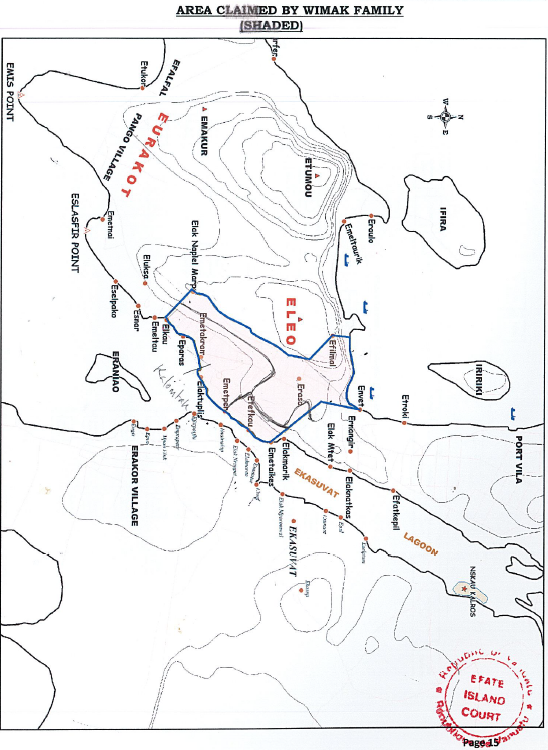
117. As can be seen from the judgment and the map filed with the claim, Family Wimak’s claimed boundary went beyond the second map and expanded boundaries claimed by the original claimant, as it included land from Emetaikes down to Emetper. There is no evidence that their claim and map was advertised.
118. Family Kalotiti Kaltapang also claimed custom land beyond the second map and expanded boundaries, as evidenced by their map and the boundaries detailed in the judgment. They also claimed land from Etefkau down to Emetper.
119. There is no evidence that the second map and expanded boundaries claimed by the original claimant in 2007 was advertised, which was mandatory if the EIC was to determine the claim based on the second map and expanded boundaries. There is no evidence that the land claimed by the counterclaimants (particularly beyond the expanded claim) was advertised, which should have occurred if the EIC permitted counterclaims beyond the 1995 advertised map. That said, we recognize the counterclaimants were responding to the original claimant’s second map and expanded boundaries.
120. We consider that in 2007, the EIC was either obliged to require advertisement of the claimant’s second map and boundaries or should have limited the original claimant to the map advertised in 1995, and required them to identify the boundaries on the map.
121. In its judgment, the EIC said it was sitting to determine the custom owners of the land boundaries which the original claimants and descendants of Chief Kalpram Cooke Maseiman referred to the Court in 1995. [42] But that is not what the EIC did. It made declarations of custom ownership of land which went well beyond the land claimed in 1995, because the declarations were based on the second map and not the original claim.
122. We consider that the EIC fell into error.
123. Firstly, this is because the EIC allowed the claimant to file a sketch map with boundaries exceeding the original advertised claim. As we have said, by order dated 24 May 2007, the EIC directed the claimant to provide the boundaries of the Eleo/Eurakot custom land claimed in 1995. The claimant did not do that. Rather, a new map was filed in November 2007, claiming a much greater area of custom land, than claimed in 1995, as evidenced by the second map and the description of the boundaries. The EIC permitted this and then heard and determined the custom land ownership dispute in accordance with the second map and boundaries, and not the map filed with the original claim in 1995.
124. While the original boundaries claimed are not known, the second map and boundaries mean the original claimant was seeking a declaration of custom ownership of a much larger area. The claimed boundary followed the seashore on the Erakor side from Emetper to E-farfer. That land was not included on the map advertised in 1995. The second map and boundaries included land on the Ifira side from E-farfer along the seashore right around to Envet. It is clear that the original claim did not include all the land from E-farfer along the coast to Envet. A small area of the seashore was included in the yellow shaded map, but it did not extend as far as Ifira around and around the point and along the coast to E-farfer as it shown on the second map and the boundary description.
125. Secondly, there is no evidence the EIC required the second map and extended boundaries to be advertised. We observe that the EIC did not mention the advertisement of the second map and expanded boundary in the judgment, as might have been expected. The judgment is also silent as to why the EIC considered the second map and not the original claim advertised in 1995. Advertisement of the second map and claim was mandatory, having regard to rule 1(7) of the Island Courts Rules. If the EIC was to determine the claim for a significantly greater area of land, then that expanded claim had to be advertised. As was said in Kaltapau v Kolou, this is because the public advertisement of a land ownership claim calls for competing claims to the advertised land, and, if the advertised land area is later allowed to be expanded to include other lands and/or questions, it is very likely that the original claimant will have no interest in the expanded areas but, even more disconcerting, is that other persons with genuine competing claims to the expanded land areas, might well be denied the opportunity to lodge their competing claims because of a lack of any advertisement of the expanded areas calling for competing claims.
126. Another reason was identified by the Court of Appeal in Raupare v Raupare, being that the judgment of the Court determines for the world at large who owns the land, it must be one that binds all those people who might have an interest in the land. A judgment would not bind those people unless they are before the Court as parties.
127. Accordingly, the EIC erred in the exercise of its statutory function. There was a jurisdictional error in that the EIC did not confine itself strictly to the 1995 advertised claim. The Court expressly said it was determining the custom owners of the land boundaries referred to the Court in 1995 by the original claimant. However, the EIC instead entertained and determined custom land areas outside the 1995 advertised area, and without any explanation as to why it did so. It should not have done, as the expanded boundaries were not advertised, as mandated by the Island Courts Rules. That denied others with competing claims, such as the fifth appellant, the opportunity of lodging a competing claim.
128. If the EIC was prepared to permit a claim for the expanded boundaries, the claim had to be readvertised, so that others who may have had a claim, could be heard. There is no evidence the expanded boundaries were advertised in 2007, as we have said. Given these errors, the appeal will be allowed.
129. The question then arises as to whether we set the whole judgment aside. It was contended that if we determined there was a jurisdictional error, then the declaration made in favour of Family Cook Maseiman in relation to Eleo/Eurakot should stand, as was the position in Uritalo v Chillia.
130. In our view, the whole judgment must be set aside, for the following reasons:
a. The actual boundaries of the original 1995 claim were not properly identified, as there was no sketch map with landmarks identified as required.
b. More relevantly, the 1995 boundaries were not visited and inspected, as required by rule 6(10) of the Island Courts Rules. This is because the Court walked the boundaries of the second map and expanded boundaries.
c. Further, we are unable to identify what declarations should stand or be set aside, given the expanded boundaries.
131. As we have allowed the appeal on the basis the EIC erred in the exercise of its statutory function, and set aside the judgment, then it is unnecessary to consider any other appeal grounds.
Should the land claim be remitted to the EIC for rehearing?
132. As we have said, during the hearing, we asked counsel and parties for their views as to whether the claim should be remitted to the EIC for rehearing, or whether the parties should simply be at liberty to have the claim determined under the Custom Land Management Act (“CLM Act”). Some parties favoured a rehearing by the EIC and others proposed that the parties be free to initiate a process under the CLM Act. Both approaches have been adopted by the Supreme Court. [43]
133. On balance, we consider the claim is to be remitted to the EIC for rehearing, and for the Court to be reconstituted. We consider that a remittal to the EIC is the better way for the claim to be reheard, given there are records available, there are a large number of parties and there are clearly defined procedural rules, particularly in relation to public notice of claims, which the parties are now aware of, to ensure natural justice.
Result
134. For the reasons given above, we make the following orders:
a. The appeal is allowed.
b. The judgment of the EIC concerning declarations of custom ownership of land is set aside, and quashed.
c. The matter is remitted to the Efate Island Court for rehearing.
d. The Efate Island Court is to be reconstituted to rehear the claim.
e. Each party is to bear their own costs.
DATED at Port Vila this 11th day of September 2026
BY THE COURT
………………………………………………………………………………………………
Hon. Justice M A MacKenzie,
sitting with assessors Justice Jonah Kalserei and Justice Diana Kalsong
[1] The letter is contained in the EIC records. All counsel and parties were granted leave to access and review the EIC records after the adequacy of the EIC records was raised with the Court.
[2] In this judgment, the map is not in color, although the original map shows the yellow shading. The yellow shading is shown on the map if the judgment is read electronically. This applies to all colored maps filed in the EIC.
[3] See p 6 of the English version of the judgment.
[4] At page 9.
[5] See page 2 of the translated judgment.
[6] See letter of support dated 1 July 2026, received on 3 July 2026. Also during oral submissions on 3 July 2026, the thirteenth respondent’s representative confirmed the original claimant provided a new boundary map.
[7] At p6 of the English version of the EIC judgment.
[8] See pp 6 and 33 of the English version of the EIC judgment.
[9] This was the actual declaration made by the EIC. We infer there was a spelling mistake made by the EIC, which had earlier referred to the ancestral custom boundaries of Ettoomoo.
[10] [2026] VUCA 48
[11] After 1 July 2024.
[12] See Minutes/Orders and Rulings issued between 2 August 2024 and 31 August 2026.
[13] See Minute/Orders dated 16 September 2026.
[14] See Minute/Orders dated 16 September 2026, 23 February 2026 and 17 April 2026.
[15] See Matarave v Talivo [2010] VUCA 3.
[16] See Ruling dated 8 September 2026.
[17] See Minute dated 17 April 2026.
[18] Submissions, applications, motions and a position statement that the second appellant asks the Court to consider were filed on 18 December 2025, 4 March 2026, 6 March 2026, 15 April 2026, 22 May 2026, 29 June 2026, 9 July 2026, 3 August 2026, 18 August 2026, 27 August 2026 and 1 September 2026.
[19] Position paper on the customary boundary of Pango at Eurokot dated 9 July 2026.
[20] The Court will explain later in this judgment the origin of the “does not go the sea” comment.
[21] Second appellant’s motion of 1 September 2006.
[22] See submissions filed on 3 August 2026 at paragraphs 281 and 282.
[23] See submissions filed on 29 June 2026.
[24] Written submissions filed 25 June 2026 at paragraph 10.
[25] Letter dated 1 July 2026.
[26] At page 56 of the English version of the EIC judgment.
[27] The second appellant, the third appellant, the fifth appellant, the sixth appellant, the first respondent and fourteenth respondent.
[28] See Minute dated 29 July 2026.
[29] See Minute dated 18 August 2026.
[30] The contentions are set out in the documents filed by the second appellant on 3 August 2026 and 1 September 2026.
[31] At p 56 of the English version of the EIC judgment, the EIC said “it would appear that Family Bakokoto I and II, Family Henden Kalsakau, Mantoi Kalsakau III, Family Nareo Lagole from Ifira and the other claimants from Erakor and Pango are claiming an interest in the same area of land.”
[32] See Minute dated 2 August 2024.
[33] See the second appellant’s submissions filed on 29 June 2026.
[34] See submissions filed on 15 April 2026.
[35] submissions filed on 29 June 2026.
[36] See Minute/Order dated 7 May 2025.
[37] See submissions filed on 3 August 2026 at paragraphs 164-170.
[38] dated 28 April 2009.
[39] As contained in an application dated 4 March 2026.
[40] See s 27 of the Island Courts Act, which records that no legal practitioner shall be entitled to take part in the proceedings of an island court.
[41] At paragraphs 10 and 11.
[42] At p 56 of the English version of the EIC judgment.
[43] See for example, Kalsakau v Manrealima [2022] VUSC 14, Kalulu v Sope [2024] VUSC 386, Tangis v Nov [2026] VUSC 150.
[2] In this judgment, the map is not in color, although the original map shows the yellow shading. The yellow shading is shown on the map if the judgment is read electronically. This applies to all colored maps filed in the EIC.
[3] See p 6 of the English version of the judgment.
[4] At page 9.
[5] See page 2 of the translated judgment.
[6] See letter of support dated 1 July 2026, received on 3 July 2026. Also during oral submissions on 3 July 2026, the thirteenth respondent’s representative confirmed the original claimant provided a new boundary map.
[7] At p6 of the English version of the EIC judgment.
[8] See pp 6 and 33 of the English version of the EIC judgment.
[9] This was the actual declaration made by the EIC. We infer there was a spelling mistake made by the EIC, which had earlier referred to the ancestral custom boundaries of Ettoomoo.
[10] [2026] VUCA 48
[11] After 1 July 2024.
[12] See Minutes/Orders and Rulings issued between 2 August 2024 and 31 August 2026.
[13] See Minute/Orders dated 16 September 2026.
[14] See Minute/Orders dated 16 September 2026, 23 February 2026 and 17 April 2026.
[15] See Matarave v Talivo [2010] VUCA 3.
[16] See Ruling dated 8 September 2026.
[17] See Minute dated 17 April 2026.
[18] Submissions, applications, motions and a position statement that the second appellant asks the Court to consider were filed on 18 December 2025, 4 March 2026, 6 March 2026, 15 April 2026, 22 May 2026, 29 June 2026, 9 July 2026, 3 August 2026, 18 August 2026, 27 August 2026 and 1 September 2026.
[19] Position paper on the customary boundary of Pango at Eurokot dated 9 July 2026.
[20] The Court will explain later in this judgment the origin of the “does not go the sea” comment.
[21] Second appellant’s motion of 1 September 2006.
[22] See submissions filed on 3 August 2026 at paragraphs 281 and 282.
[23] See submissions filed on 29 June 2026.
[24] Written submissions filed 25 June 2026 at paragraph 10.
[25] Letter dated 1 July 2026.
[26] At page 56 of the English version of the EIC judgment.
[27] The second appellant, the third appellant, the fifth appellant, the sixth appellant, the first respondent and fourteenth respondent.
[28] See Minute dated 29 July 2026.
[29] See Minute dated 18 August 2026.
[30] The contentions are set out in the documents filed by the second appellant on 3 August 2026 and 1 September 2026.
[31] At p 56 of the English version of the EIC judgment, the EIC said “it would appear that Family Bakokoto I and II, Family Henden Kalsakau, Mantoi Kalsakau III, Family Nareo Lagole from Ifira and the other claimants from Erakor and Pango are claiming an interest in the same area of land.”
[32] See Minute dated 2 August 2024.
[33] See the second appellant’s submissions filed on 29 June 2026.
[34] See submissions filed on 15 April 2026.
[35] submissions filed on 29 June 2026.
[36] See Minute/Order dated 7 May 2025.
[37] See submissions filed on 3 August 2026 at paragraphs 164-170.
[38] dated 28 April 2009.
[39] As contained in an application dated 4 March 2026.
[40] See s 27 of the Island Courts Act, which records that no legal practitioner shall be entitled to take part in the proceedings of an island court.
[41] At paragraphs 10 and 11.
[42] At p 56 of the English version of the EIC judgment.
[43] See for example, Kalsakau v Manrealima [2022] VUSC 14, Kalulu v Sope [2024] VUSC 386, Tangis v Nov [2026] VUSC 150.