Shadrack v Electoral Commission
REASONS FOR DISMISSING URGENT JUDICIAL REVIEW CLAIM
Introduction
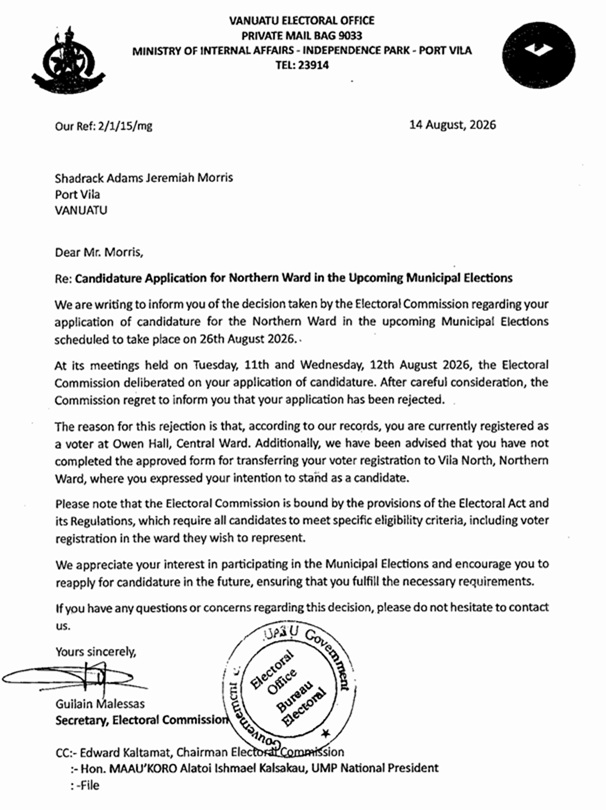
1. The Port Vila Municipal Council elections are to be held on 26 August 2026. Mr Shadrack was nominated to stand as a candidate in the Northern ward. The nomination was lodged by his political party. However, Mr Shadrack’s application to be a candidate for the Northern ward in the Port Vila Municipal election was rejected by letters dated 14 August 2026 and 17 August 2026.
2. The Electoral Commission said that it was bound by the provisions of the Electoral Act and its Regulations, which require all candidates to meet specific eligibility criteria, including voter registration in the ward they wish to represent. The Commission rejected the application for two reasons:
(a) Mr Shadrack is currently registered as a voter at Owen Hall, Central ward; and
(b) Mr Shadrack did not complete the approved form for transferring his voter registration to Vila North, Northern ward where he seeks to stand as a candidate.
3. The Electoral Commission’s decision of 14 August 2026 as to the invalidity of the nomination is the primary decision under review. I set out the letter in full:
Chronology of relevant events
4. The background context to the rejection of Mr Shadrack’s nomination application to stand as a candidate, is important. I set out a timeline of relevant events as follows:
• Between 1-14 July 2026 - The period for candidate nominations and voter inspection for the Port Vila Municipal Council elections.
• On either 12 July 2026 or 14 July 2026 - Mr Shadrack attended at the Vila North School inspection site. He presented his national ID card to verify his voter details on the Vila North school voter inspection list. Mr Shadrack’s residential address on his National ID card was Independence Park. The nearest polling station to Independence Park is Owen Hall. Mr Shadrack was advised to go to the Civil Registry to update his residential address and return to the Villa North School. The voter inspection officers say he did not return until 5 pm 14 July 2026 when the site was closing for the inspection exercise.
• 14 July 2026 - The Electoral Commission received Mr Shadrack‘s nomination form at 2.45 pm. Mr Shadrack’s nomination was to stand as a candidate for the Union of Moderate Parties (“UMP”) in the Northern ward.
• 3 August 2026 - Mr Shadrack was advised by telephone that the electoral records showed he was registered to vote at Owen Hall, independence Park.
• 4 August 2026 - Mr Justin Ngwele, then counsel for Mr Shadrack, wrote an extremely comprehensive and thorough letter to the Electoral Commission advocating for Mr Shadrack about the voter registration issue and asked the Commission to take immediate action. [1]
• 5 August 2026 - the voter list inspection officers stationed at Vila North School inspection site between 1 July – 14 July 2026, completed a statement as to their interactions with Mr Shadrack on 14 July 2026. [2]
• 11 August 2026 - The Electoral Commission met to approve candidates for the 2026 Port Vila Municipal Council elections. Mr Shadrack was one of two candidates who were rejected as not been qualified. His application was rejected for failing to register with the Vanuatu Electoral Commission Office using the approved form. [3]
• 12 August 2026 - Mr A I Kalsakau sent a letter to the Principal Electoral Officer in his capacity as president of the UMP. This letter was sent following a meeting Mr Kalsakau had with the Principal Electoral Officer at lunchtime on 12 August 2026 in relation to Mr Shadrack’s nomination as a candidate in the Port Vila Council elections. [4]
• 14 August 2026 - The Electoral Commission’s decision to reject Mr Shadrack’s application was communicated to Mr Shadrack by letter.
• 16 August 2026 - Mr A I Kalsakau again wrote to the Electoral Commission advocating for Mr Shadrack and asking the Commission to accept Mr Shadrack’s nomination forthwith. Mr Kalsakau pointed out that Mr Shadrack is a permanent resident and voter in the Northern ward and voted there in previous elections. Amongst other things, Mr Kalsakau contended:
i. The commission had proved no statutory citation authorising it to treat civil registry records as insufficient for nomination purposes.
ii. That any alleged failure to complete Form B is at most a technical, remediable omission.
iii. That there is nowhere in section 45 of the Electoral Act No. 16 of 2023 nor in any other provision of that Act that disqualifies Mr Shadrack from contesting the Municipal elections.
iv. That the commission must identify the precise statutory regulatory provision it relies upon if it maintains its position that Mr Shadrack was ineligible to stand as a candidate in the Northern ward.
v. That Mr Shadrack has never voted at Owen Hall/Independence Park. For the last 3 elections he voted at the Northern ward polling place, where he has lived all his life.
• 17 August 2026 - Mr Shadrack’s application was again considered by the Electoral Commission and was rejected for the same reasons as set out in the 14 August 2026 letter.
Judicial Review claim
5. On 19 August 2026, Mr Shadrack filed an urgent judicial review claim, seeking that time be abridged. By way of relief, a number of orders are sought, being: [5]
(a) A declaration that the Electoral Commission’s decisions communicated by letters dated 14 August 2026 and 17 August 2026 refusing to accept Mr Shadrack’s nominations is an unlawful administrative action and is of no force and effect.
(b) An order quashing the Commission’s decisions of 14 August 2026 and 17 August 2026.
(c) A mandatory order directing the Electoral Commission to accept and register the nomination of Mr Shadrack forthwith and to take all administrative steps necessary to place his name on the ballot for the Northern ward in the Port Vila Municipal Elections scheduled for 26 August 2026.
(d) A declaration that a Civil Registry ID card dated 14 July 2026 issued by the Civil Registry is a valid and sufficient official record of identity and residence for nomination purposes under the Electoral Act.
(e) Alternatively, that if the Commission requires completion of any administrative form (including form B) the Commission must permit immediate rectification/curing of that omission and accept the nomination where substantive eligibility is demonstrated by up to date official documentation.
(f) An order for costs.
(g) Such further or other relief as the Court considers just.
6. I accepted this matter was urgent. That is because the election campaign ended on Sunday 23 August 2026 and elections are to be held on 26 August 2026.
7. At a conference urgently scheduled on 19 August 2026, I made the following directions:
(a) Time to file a defence was abridged to 12 noon 20 August 2026.
(b) A rule 17.8 conference was listed for 3 pm 20 August 2026.
8. Pursuant to rule 17.8 (3) of the CPR, the Court will not hear a judicial review claim unless satisfied as to all 4 matters set out in that rule:
(a) The claimant has an arguable case; and
(b) The claim is directly affected by the decision; and
(c) There has been no undue delay in making the claim; and
(d) There is no other remedy that resolves the matter fully and directly.
9. At the rule 17.8 conference, Mr Leo, Acting Solicitor General, advised that the defendants accepted that all 4 of the criteria set out in rule 17.8(3) were met. Therefore, the claim was properly before the Court, which is all that is required at the rule 17.8 stage: Mandavah v Republic of Vanuatu [2021] VUCA 52.
10. Procedurally, the next step was to list the judicial review for a substantive hearing. Counsel both agreed there were no material factual disputes and that the hearing should procced by way of submissions only. I indicated to counsel that I was prepared to hear submissions immediately in view of the urgency. However, if counsel wanted some time, then the hearing would be listed at 8.30 am Friday 21 August 2026. After conferring with Mr Shadrack, Mr A I Kalsakau asked for the hearing to take place on 21 August 2026.
11. The hearing was listed for 21 August 2026. Counsel both filed written submissions, as I had asked them to do. Mr Kalsakau also relied on the submissions filed for the rule 17.8 conference. I also heard oral argument.
12. Later on 21 August 2026, there was a Result Order. I dismissed the judicial review claim, and made an order for costs. I said reasons would follow. These are my reasons.
Approach to judicial review
13. The crux of the judicial review claim is that the Electoral Commission’s 14 August and 17 August 2026 decisions to reject Mr Shadrack’s nomination for candidacy are unreasonable in terms of the Wednesbury principles and an unlawful administrative action.
14. In Associated Provincial Picture Houses Ltd v Wednesbury Corporation [1947] EWCA Civ 1; [1948] 1 KB 223 at 229, Lord Greene MR held that:
“It is true that discretion must be exercised reasonably. Now what does that mean? Lawyers familiar with the phraseology used in relation to exercise of statutory discretions often use the word ‘unreasonable’ in a rather comprehensive sense. It has frequently been used and is frequently used as a general description of the things that must not be done. For instance, a person entrusted with a discretion must, so to speak, direct himself properly in law. He must call his own attention to the matters which he is bound to consider. He must exclude from his consideration matters which are irrelevant to what he has to consider. If he does not obey those rules, he may truly be said, and often is said, to be acting ‘unreasonably’. Similarly, there may be something so absurd that no sensible person could ever dream that it lay within the powers of the authority. Warrington LJ in Short v Poole Corporation [1] gave the example of the red-haired teacher, dismissed because she had red hair. This is unreasonable in one sense. In another it is taking into consideration extraneous matters. It is so unreasonable that it might almost be described as being done in bad faith; and, in fact, all these things run into one another”.
Relevant statutory framework
15. The Principal Electoral Officer is to establish and maintain a voter register for elections. [6] One of the details that must be recorded for each person in the voter register is a person’s address or location of his or her place of residence. [7]
16. Before an election, the Principal Electoral Officer must make preliminary electoral lists allocating each person registered in the voter register to the closest polling station to his or her civil registration address or location recorded under s 30(g) of the Electoral Act. That preliminary list must be made available for inspection by the public for a 14 day period. [8]
17. There are two avenues to change where a person votes. Firstly, if a person’s name is not included in a preliminary electoral list, an application in the approved form may be made to the Principal Electoral Officer for inclusion onto the list. The application must be made before the end of the inspection period, as per s 34 of the Electoral Act. Section 34 provides:
34. Application for changes to preliminary electoral list
(1) Any person who is eligible for inclusion in a preliminary electoral list but whose name has not been included in the list may apply in the approved form to the Principal Electoral Officer before the end of the inspection period for the inclusion of his or her name in the list.
(2) Before the end of the inspection period, any person may apply in the approved form to the Principal Electoral Officer for:
(a) the inclusion or deletion of any names from a preliminary electoral list; or
(b) the correction of any matter in a preliminary electoral list; or
(c) the addition or deletion of any matter in a preliminary electoral list.
(3) The Principal Electoral Officer must decide an application as soon as practicable and notify the applicant in writing of his or her decision, and the action taken (if any) to give effect to the decision.
(4) The Principal Electoral Officer's decision on an application is final.
18. Secondly, pursuant to s 31 of the Electoral Act, a voter registration can be changed from one constituency to another. Section 31 provides:
31. Changes to registration
(1). A person may apply:
(a) to the returning officer for a constituency for his or her registration in the Voter Register to be transferred to that constituency from another constituency; or
(b) to the returning officer for the constituency for which he or she is included in the Voter Register to amend any of the person's registration details.
(2) The application must
(a) be made in the approved form; and
(b) be accompanied by evidence sufficient to support the application as prescribed by the Regulations: and
(c) be made during the period determined by Order by the Commission for the election concerned.
(3). The returning officer must approve an application if he or she is satisfied that the applicant is eligible for registration in that other constituency or the amendments to the applicant's details are correct.
(4) The returning officer's decision is final.
19. Section 45 of the Electoral Act relevantly sets out the criteria for qualification to stand as a candidate in an election. Section 45 says:
45. Qualification of candidates
(1). A person is qualified to stand as a candidate in an election if he or she:
(a) is registered as a voter in the Voter Register; and
(b) has attained the age of:
(i) 25 years for an election for the Parliament: and
(ii) 21 years for a Municipal Council or a Provincial Government Council election: and
(c) is a citizen of Vanuatu; and
(d) has not received a sentence including a suspended sentence of a term or terms of imprisonment which has not ended; and
(e) is not an undischarged bankrupt;
(f) and is a person who is not in default of a payment of rates, charges or other debts totalling VT 5000 or more due to:
(i) the Government or a Government agency within the meaning of the Public Finance and Economic Management Act [CAP 2441; or
(ii) a Provincial Government Council: or
(iii) a Municipal Council,
for a period exceeding 2 months after the payment becomes due; and
(g) is not disqualified under section 44, and
(h) in the case of a person who intends to stand as a candidate in a constituency for election to a Provincial Government Council or Municipal Council, is registered as a voter in and resides in that constituency at the time of his or her nomination as a candidate for the election.
….
20. Pursuant to s 48 of the Electoral Act, it is mandatory for the Electoral Commission to decide whether the nomination of a proposed candidate is valid or invalid. Section 48 provides:
48 Invalidity of nomination of candidate
(1) The Commission must decide whether the nomination of a person to stand as a candidate in an election is valid or invalid.
(2) The nomination of a person is invalid if:
(a) the person
(i) is disqualified for election under section 44; or
(ii) does not meet the qualification for election requirements under section 45: or
(iii) is already nominated as a candidate in another constituency; or
(b) the nomination was not made in accordance with the requirements of section 46 or 50 (if applicable); or
(c) one or more of the nominators of the person are not eligible to nominate him or her.
(3) If the Commission decides that the nomination of a person is invalid, the Commission must:
(a) record the decision and the reasons for it on the nomination form: and
(b) give the person or one of the person's nominators a copy of the nomination form with the decision recorded.
(4) The decision of the Commission that a nomination is invalid is final.
(5) If the Commission decides that:
(a) a person's nomination as an independent candidate is invalid. the person may be nominated again to stand as a candidate for election within the nomination period or such other period determined by the Commission; and
(b) the nomination of candidate sponsored by a political party is invalid, another candidate sponsored by the same political party may lodge a nomination of candidature no later than 48 hours after the end of the nomination period.
(6) If after deciding that a person's nomination of candidature is valid (original decision). whether or not the nomination has been published in the Gazette, the Commission:
(a) becomes aware of new information; and
(b) is satisfied that the person's nomination would have been invalid under subsection (2) had the Commission been aware of the new information at the time it made the original decision,
the Commission may in writing declare the nomination is invalid and the declaration takes effect on the day on which it is made.
(7) If a person's nomination of candidature is declared invalid under subsection (6). the Commission must give the person a copy of the declaration together with a statement of reasons for the decision.
(8) The decision of the Commission under subsection (6) that a nomination is invalid is final.
Discussion
21. Mr Kalsakau contended there were two central legal issues:
a. Whether the Electoral Commission lawfully refused Mr Shadrack’s nomination when he produced an up-to-date National ID card on 14 July 2026, which showed Mr Shadrack resided in the Northern ward; and
b. Whether alleged non completion of Form B may be treated as an absolute bar to nomination without notice or opportunity to remedy.
22. The Electoral Commission has a statutory obligation to decide if the nomination of a proposed candidate for a Municipal Council Election is valid or invalid. It must give a decision and reasons for the decision. In order to decide whether the nomination is valid or invalid, it must be assessed against the statutory criteria, and in particular s 45 of the Act. Section 45 sets out the qualification criteria for a person to stand as a candidate in an election. A candidate nomination is invalid if the person does not meet the qualification for election requirements under s 45 of the Act.
23. Saliently, an intended candidate for election to a Municipal Council constituency must be registered as a voter in, and reside in, the constituency they wish to stand in as a candidate at the time of nomination as a candidate.
24. Mr Shadrack’s nomination as a candidate was assessed to be invalid by the Electoral Commission. As can be seen by the statutory scheme, such an assessment is mandatory. As I have said, two reasons were given:
(a) That according to the Electoral Commission’s records, Mr Shadrack was currently registered as a voter at Owen Hall, Central Ward; and
(b) That he had not completed the approved form for transferring his voter registration to Vila North, Northern Ward, where he wants to stand as a candidate.
25. The 14 August 2026 letter also noted that the Electoral Act and regulations require all candidates to meet specific eligibility criteria, including voter registration in the ward they wish to represent. The 17 August 2026 letter upheld the initial rejection and was in response to Mr Kalsakau’s second letter to the Electoral Commission asking the Commission to review the rejection of Mr Shadrack’s nomination.
26. On 12 or 14 July 2026, Mr Shadrack went to Vila North School to have his National ID card scanned by electoral registration officers. [9] This was during the 1-14 July 2026 inspection period for the voter register. The Vanuatu National ID card presented by Mr Shadrack listed his residence as Independence Park. He says he has lived in Hollen Freshwind, the Northern ward, his whole life. Further that he has voted at the Northern ward polling station since he was first eligible to vote. Mr Shadrack did not explain in his sworn statement why then his National ID card recorded his residence at Independence Park, and why he had not taken steps previously to rectify this. A National ID card is valid for 10 years for a person aged over 18 years, which Mr Shadrack is. [10] I infer that Mr Shadrack had recently renewed his National ID card with the Independence Park address as it did not expire until 19 January 2036. It must have been issued with the Independence Park address because that address was the address in the Population Register. [11]
27. Mr Shadrack was advised by the inspection officers at Vila North School that his National ID card showed he was registered to vote at Owen Hall, which Mr Shadrack denies. The difficulty for Mr Shadrack was that because his National ID card showed his address as Independence Park, I infer he was registered in the voter register to the closest polling station to his civil registration address. As set out above, by virtue of s 32 of the Electoral Act, the Principal Electoral Officer is obliged to make preliminary electoral lists allocating each person registered in the voter register to the closet polling station to his or her civil registration address. Because his civil registration address was Independence Park, he was not shown on the preliminary list for the voter register as a voter in the Northern ward.
28. On 14 July 2026, Mr Shadrack went to the Civil Registry Department and updated his National ID card to record his residence as the Hollen Freshwind area. He was issued with an updated National ID card as a result. Mr Kalsakau’s primary contention was that the Principal Electoral Officer should then have acted on the correct address on Mr Shadrack’s National ID card, and updated the voter register to the Northern ward. In other words, it was the responsibility of the Principal Electoral Officer to do that, and not Mr Shadrack.
29. The issue though is not only Mr Shadrack’s residence but where he was registered to vote. On the basis that Mr Shadrack was registered to vote at Owen Hall, he needed to take the steps set out at either ss 31 or 34 of the Electoral Act to either change the constituency where he voted, or to have his name included in the preliminary electoral list in the Northern ward. It was a mandatory step on his part to do this by filing the approved form as per the processes set out in ss 31(2) or 34(2) of the Electoral Act. Mr Shadrack did not do this. He simply rectified his address details.
30. However, in accordance with either ss 31 and 34 of the Act, it was Mr Shadrack’s responsibly to change his voting constituency, or to apply to be included in the preliminary electoral list for the Northern ward, once he became aware that he was not in the voter register for the Northern ward, where he wanted to stand as a candidate. I reject the contention that this was not his responsibility, but rather it was for the Principal Electoral Officer to advise him to complete Form B or take the step to place Mr Shadrack on the voter register for the Northern ward. [12]
31. The statutory wording in both ss 31 and 34 is clear and unambiguous. There is nothing in the legislation that places responsibility on the Principal Electoral Officer to either advise a potential candidate to make the applications contemplated by either ss 31 or 34, or to require him or her to take the step of placing Mr Shadrack on the Northern ward voter register, without an application in the approved form. To the contrary, the relevant provisions required Mr Shadrack to make the necessary application in the approved form. The form was annexed to Mr Kaltamat’s sworn statement and does not look onerous.
32. The question of qualification for nomination as a candidate in a municipal election is not a matter of discretion. The Electoral Commission must comply with the statutory scheme. Either a person is validly nominated or not. Based on the information available to the Electoral Commission, Mr Shadrack was not registered to vote in the constituency that he proposed to be a candidate at the time of his nomination as a candidate. While I accept that Mr Shadrack has previously voted in the Northern ward, that is not what the records held by the Electoral Commission showed on the preliminary electoral list. That was because Mr Shadrack’s civil address as shown on his National ID card was Independence Park. There was a process to follow to change constituency voter registration, or to be included in the preliminary electoral list for the Northern ward, which Mr Shadrack did not follow. While I accept Mr Kalsakau’s submission that failure to file the approved form as either required by ss 31(2) or 34(2) of the Electoral Act is a remediable defect, it is not a matter of discretion. It is a step that had to be undertaken in accordance with the legislation in order to change the voter constituency.
33. I accept that Mr Shadrack has always lived in Hollen Freshwind, which makes it curious that Independence Park was the address on his National ID card, which must have been recorded in the Population Register. I further accept that at some point on 14 July 2026, Mr Shadrack changed his residence on his National ID card to reflect his actual residential area, Hollen Freshwind. To qualify to stand as a candidate in a constituency for election to a Municipal Council, he had to be both be registered as a voter and reside in that constituency at the time of his nomination as a candidate, but he did not take the step required of him under the Electoral Act to ensure he was registered as a voter in the Northern ward.
34. Thus, I do not accept Mr Kalsakau’s contention that the process and decision was procedurally flawed and therefore unlawful. The Electoral Commission was not exercising a discretion. It is mandatory for the Commission to decide whether the nomination of a proposed candidate is valid or invalid. The Commission was acting in accordance with its statutory obligations. The decision is final. [13] However, if the Commission decides a nomination for a candidate sponsored by a political party is invalid, as it did in Mr Shadrack’s case, s 48(5) preserves the ability for another candidate sponsored by the same political party to lodge a candidate nomination for the election. In the event of an invalid independent candidate nomination, he or she may be nominated again to stand as a candidate at the election. There are time limits in both situations. So, if the Commission decides a candidate nomination is invalid, there is a pathway for candidate nomination for the same election, depending on whether the nominated candidate is sponsored by a political party or is an independent candidate. That is procedurally fair.
35. In the 14 August 2026 letter, the Electoral Commission gave reasons why it assessed Mr Shadrack’s nomination to be invalid. It was not because of the address on his National ID card, but rather that he was not registered to vote at Vila North, Northern ward. According to the Electoral Commission’s records, Mr Shadrack was registered as a voter at Owen Hall, Central ward. As I have said, I infer that was because it was the closest polling station to the address shown on his national ID card, as per the preliminary electoral list. The reasons given were sufficient because the Commission identified why Mr Shadrack’s application to stand as a candidate in the Northern ward was rejected. It was because according to the voter records, Mr Shadrack was registered as a voter at Owen Hall, Central ward and had not completed the approved form for transferring voter registration to Vila North, Northern ward, where he wants to stand as a candidate.
36. The Commission correctly pointed out that it is bound by the provisions of the Electoral Act, which requires all candidates to meet specific eligibility criteria, including voter registration in the ward they wish to represent. With respect, they were not required to identify specific sections. The Electoral Commission properly identified why Mr Shadrack did not meet the qualification criteria regarding voter registration, as set out in s 45 of the Act. It is for the Commission to ensure the integrity of all elections, and one of the ways to do that is to make sure that all intended candidates meet the qualification criteria.
37. The judicial review application pleads that Mr Shadrack was not given an opportunity to respond, which was procedurally unfair. I do not accept that Mr Shadrack was denied natural justice by not being able to respond. I consider that natural justice was served, because once the issue about voter registration was known to Mr Shadrack on 3 August 2026, extensive submissions were made to either the Principal Electoral Officer or the Electoral Commission on his behalf, asking for the decision to be reversed. Mr Ngwele sent an extensive letter to the Commission on 4 August 2026, Mr Kalsakau had a meeting with the Principal Electoral Officer on 12 August 2026, which was followed up with a letter to the Principal Electoral Officer that same day. Then after the 14 August 2026 rejection letter, Mr Kalsakau wrote a further comprehensive letter to the Electoral Commission, providing an explanation, and asking them to reconsider the rejection. The electoral commission did so and responded on 17 August 2026 upholding the initial rejection. I assess that Mr Shadrack then had multiple opportunities to be heard. In fact, via the representations made on his behalf by both Mr Ngwele and Mr Kalsakau, the Electoral Commission knew what Mr Shadrack’s position was.
38. In light of my view that in the circumstances of this case, Mr Shadrack was afforded natural justice, I do not necessarily need to consider whether there is a natural justice requirement. But I will consider this issue briefly. I accept that where there is no specific provision in legislation setting out a procedural fairness procedure, it is still required. [14] There are however exceptions to the general rule regarding procedural fairness. In so far as the validity or otherwise of a candidate’s nomination, there is not specific provision for procedural fairness. [15] Section 48 of the Electoral Act provides that a decision whether a nomination of a proposed candidate is valid or invalid is final. That reflects the Commission’s statutory obligation to decide whether a nomination is valid or invalid, which they can only do by applying the qualification criteria in section 45 of the Electoral Act and any other relevant statutory provisions. The Commission is not exercising a discretion. It is mandatory. The finality of the decision is a clear indicator from Parliament that there is no requirement for an opportunity to respond. I consider that s 48 leaves no room for any rule of natural justice to be implied. A procedural fairness requirement would significantly undermine the finality of decisions under s 48. In any event, as I have said, if the Commission decides a candidate nomination is invalid, s 48(5) preserves a pathway for candidate nomination for the same election, depending on whether the nominated candidate is sponsored by a political party or is an independent candidate. That introduces procedural fairness once a decision is made.
39. I have not addressed Mr Kalsakau’s argument that the Principal Electoral Officer should have exercised his discretion under s 49 of the Electoral Act to decide that Mr Shadrack’s failure to complete Form B (the approved form) was a bone fide error. If there is a bone fide error, the Electoral Commission may ask the candidate to resubmit a valid nomination. I have not done so because the decisions under review were the decisions of 14 August and 17 August 2026 determining the candidate nomination was invalid. They were the decisions in relation to a public function sought to be reviewed. [16] The Principal Electoral Officer’s decision or lack of decision was not pleaded in the urgent judicial review application. [17]
40. There was another issue raised by Mr Kalsakau. He contended that a change of registration contemplated by the Electoral Act cannot be read in any other way than a change from a municipal constituency to another Municipal, Provincial or Parliamentary constituency. He contended that it is material that the Electoral Act contains no provision distinguishing a “ward” from the municipal constituency of Port Vila. Thus, any suggestion that the Electoral Act contemplates different registration, eligibility or procedural rules for wards as distinct from the municipal constituency of Port Vila lacks statutory foundation and should be rejected. In essence, Mr Kalsakau contended that because Mr Shadrack was registered as a voter in the Port Vila Municipal constituency, he met the qualification criteria in section 45 of the Electoral Act. His contention must be that “constituency” means the Port Vila municipal constituency.
Relevant statutory provisions
41. The Electoral Act must be read in conjunction with the Municipalities Act [CAP 126], which sets out that the election of members of a Municipal Council is to be held in accordance with the Electoral Act No. 16 of 2023 (“the Electoral Act”) and the Regulations made under the Act. [18] While municipal elections are now conducted under the Electoral Act, Orders relating to municipal elections made under the Municipalities Act continue to be in force, as I will explain.
42. Section 2 of the Electoral Act defines “election” and “constituency” as follows:
election means an election for members of:
(a) a parliamentary constituency;or
(b) a provincial constituency;or
(c) a municipal constituency.
constituency means:
(d) a parliamentary constituency; or
(e) a provincial constituency; or
(f) a municipal constituency.”
municipal constituency means a constituency in relation to a municipality determined under subsection 6 (3).
43. Section 6 of the Electoral Act provides:
6. Members of Parliament, Councillors and Electoral constituencies
….
(3). The Commission may by Order:
(a) divide a municipality into one or more municipal constituencies for the purposes of Municipal Council elections: and
(b) prescribe the number of councillors to be elected in respect of each municipal constituency; and
(c) distribute the seats for the councillors among the constituencies.
….
44. Relevantly, the interpretation section of the Municipalities Act provides that [19] a “municipality” means a town or city that has its own Municipal Council, and “Ward Area” means the territorial boundary within each municipal boundary.
45. The Port Vila Municipality (Composition of Council and Wards) Order 21 of 1980 (“the Order”), as amended by Order No. 66 of 2013, Order No. 69 of 2013, Order No.152 of 2013, Order No. 153 of 2013, and Order No. 77 of 2021, issued under the Municipalities Act, divides the Port Vila City Council into wards. Section 133(3) of the Electoral Act allows any Regulation, Order, notice or other instrument made under s 7 of the Municipalities Act, [20] that was in force immediately before the commencement of the Electoral Act, continue with necessary modifications, until repealed or revoked. These Orders have not been revoked. Therefore, the ward system for voting in the Port Vila Municipal Council elections continues to apply.
46. Pursuant to section 8 of the Interpretation Act [CAP 132], every Act must be interpreted in such manner as best corresponds to the intention of Parliament. Section 8 provides:
PART 3 – ACTS OF PARLIAMENT AND STATUTORY ORDERS
8. General principles of interpretation
(1) Every Act must be interpreted in such manner as best corresponds to the intention of Parliament.
(2) The intention of Parliament is to be derived from the words of the Act, having regard to:
(a) the plain meaning of ordinary words; and
(b) the technical meaning of technical words; and
(c) the whole of the Act and the specific context in which words appear; and
(d) headings and any limitation or expansion of the meaning of words implied by them; and
(e) grammar, rules of language, conventions of legislative drafting and punctuation.
(3) Where the application of subsection (2) would produce:
(a) an ambiguous result; or
(b) a result which cannot reasonably be supposed to correspond with the intention of Parliament, the words are to receive such fair and liberal construction and interpretation as will best ensure the attainment of the object of the Act according to its true intent, meaning and spirit.
(4) In applying subsection (3), the intention of Parliament may be ascertained from:
(a) the legislative history of the Act or provision in question; and
(b) explanatory notes and such other material as was before Parliament; and
(c) Hansard; and
(d) Treaties and International Conventions to which Vanuatu is a party.
47. As the Court of Appeal said in August v Ombudsman of the Republic of Vanuatu [2021] VUCA 59, the starting point is to consider first the plain meaning of the section to be interpreted. [21] The Court was mindful of section 8 (3) (a) and (b) of the Interpretation Act which provided that where the result of a reading of words is ambiguous, or a result which cannot reasonably be supposed to correspond with the intention of Parliament, the words “are to receive such fair and liberal construction and interpretation as will best ensure the attainment of the object of the Act according to its true intent, meaning and spirit.” [22]
48. One of the objectives of the Electoral Act is provide a comprehensive framework for the conduct of elections, including Municipal Council Elections consistent with best practice for democratic elections. But the whole of the Act and the specific context in which words appear is also a factor in determining the intention of Parliament. Under the Electoral Act, constituencies may be Parliamentary, Provincial or Municipal. That is because the Electoral Act regulates these 3 types of elections. “Municipal constituency” is defined in the Electoral Act is a “constituency” determined under s 6(3). Section 6 (3) provides a discretion for the Commission to divide a municipality into one or more constituencies for the purposes of the Municipal Council Elections. And further to prescribe the number of councillors to be elected in respect of each municipal constituency. This provision appears to be aimed at ensuring fair representation of the people in a municipality. If constituency meant the Port Vila Municipal Council constituency, s 6 (3) would have no purpose and would be redundant.
49. I accept there is no evidence that the Electoral Commission has made any orders dividing the Port Vila municipality into one or more constituencies. However, as I have said, since 1980, the Port Vila Municipality has been divided into wards for voting. The Orders made under the Municipalities Act remain in force, and also prescribe the number of councillors for each ward. Thus, for Port Vila Municipal Council elections, the municipality is divided into electoral areas for voting. Consistent with the provisions of the Electoral Act, this must be to ensure fair representation of voters in Port Vila.
50. While there is no provision for, or definition of “wards” in the Electoral Act, there is now a definition of “ward” in the Municipalities Act, as a territorial boundary within a city that has a Municipal Council. That amendment postdated the Electoral Act, so it can be inferred that for Municipal elections, Parliament intended that a “ward” and a “constituency” are the same thing; an electoral subdivision within Port Vila.
51. In the context of a Municipal election, the word “constituency” should be interpreted as meaning a “ward”. I consider that the words “constituency” and “ward” are interchangeable. Since independence in 1980, Port Vila has defined electoral boundaries within the city as “wards”, which still lawfully exist. In such circumstances, the word “constituency” in the Electoral Act as it applies to a municipality, must have a fair and liberal interpretation, consistent with the existing division of Port Vila into wards for voting purposes. Both a “constituency” and a “ward” mean an electoral subdivision within the municipality, as I have said. To hold that Port Vila is one constituency does not make sense, as it would deny the people of Port Vila entitled to vote, fair geographical representation, and is inconsistent with the subdivision of Port Vila into wards. To be qualified as a candidate Mr Shadrack was required to be registered to vote in the constituency or ward, at the time of nomination. This was the Northern ward, and he was not registered to vote in that ward.
52. For the reasons given above, the judicial review claim is dismissed. The decisions of the Electoral Commission on 14 August 2026 and 17 August 2026 were neither unreasonable not unlawful. The Commission has a statutory duty to decide if a candidate nomination is valid or invalid. Mr Shadrack, in this case, was afforded procedural fairness, as I have said. Further, I do not accept that for voter registration purposes, there is only one constituency, the Port Vila constituency.
Result
53. The urgent judicial review claim is dismissed.
54. Costs on a standard basis as agreed or taxed.
DATED at Port Vila this 26th day of August 2026
BY THE COURT
………………………………………….
Justice M A MacKenzie
[1] The 4 August 2026 letter is 17 pages and canvasses thoroughly the issues and a number of provisions of the Electoral Act.
]2] That statement is replicated in sworn statements filed by both officers on 20 August 2026.
[3] The rejection was recorded on the nomination form as required by s 48(3) of the Electoral Act, albeit in brief. The Commission’s reasons as set out in the 14 August 2026 letter provided better detail.
[4] The 12 August 2026 letter was also copied to the Electoral Commission.
[5] I accept that, Mr Shadrack can bring a judicial review claim, as the decision made by the Electoral Commission is prior to the Municipal Election. For a post election issue, any proceeding must be by way of election petition. See Part 9 of the Electoral Act.
[6] Section 29 of the Electoral Act.
[7] Section 30 (g) of the Electoral Act.
[8] Sections 32 and 33 of the Electoral Act.
[9] There is a factual dispute as to whether Mr Shadrack went to Vila North School on 12 July (as he says) or on 14 July (as the inspection officers say). Nothing turns on this. It is not material to whether the Electoral Commission acted unreasonably and unlawfully.
[10] Section 3 of the Vanuatu National Identity Act No. 27 of 2021(“VNI Act”).
[11] The process to issue a National ID card is contained in the VNI Act. A person must apply for/renew a national ID card. Under s 8 of the VNI Act, a card must be issued if the application is made in the approved form and the applicant’s details are registered in the Central Register. The Central Register consists of civil registers and the Population Register: s 6 Civil Registration and Identity Management Act No. 28 of 2021(“CRIM Act”). A person’s address is a mandatory detail in the Population Register: s 10 CRIM Act.
[12] Form B is annexed as Exhibit EK 5 to Mr Kaltamat’s sworn statement filed on 20 August 2026.
[13] Section 48 (4) of the Electoral Act.
[14] See Kautpen v Lal [2025] VUCA 18.
[15] See Samna Local Government Council v Wells (In that case, the facts and the statutory regime created an exception to the general rule).
[16] “Decision” is defined in rule 17.2 of the CPR to mean, relevantly, “a decision... in relation to the exercise of a public function...”. See Namuri v Customary Land Management Office [2026] VUCA 45.
[17] The importance of pleadings was recently reiterated by the Court of Appeal in Ngwele v Republic of Vanuatu [2026] VUCA 50 at paragraphs 23-26.
[18] Section 6 of the Municipalities Act.
[19] The definition of “municipality” and “Ward Area” were inserted into the Municipalities Act by the Municipalities (Amendment) Act No. 48 of 2025.
[20] Before repeal, s 7 of the Municipalities Act provided for registration of voters and for elections in a territorial ward or municipality.
[21] At paragraph 15.
[22] At paragraph 18.