Napuat as Minister of Internal Affairs of the Republic of Vanuatu v Kiel
JUDGMENT OF THE COURT
Introduction
1. On 6 February 2026, the first appellant, as Minister of Internal Affairs (the Minister), made orders suspending with immediate effect the exercise of the powers of the Port Vila City Council (the Council) for a period of five months and conferring the exercise of those powers on the second appellant, Mr Bebe. The Minister said that he was exercising the power bestowed on him by s.61(3) of the Municipalities Act [Cap 126] (the Act).
2. The respondents, who are eight of the 17 elected members of the Council, brought judicial review proceedings in the Supreme Court challenging the validity of the Minister’s orders. Their principal complaint was that the Minister had denied them natural justice, but they also alleged that the Minister’s decision had been affected by bias and by regard to irrelevant matters.
3. The respondents were successful: Kiel v Napuat [2026] VUSC 104. On 12 May 2026, the primary Judge made the following orders:
a) the decision of the [Minister] suspending the powers of the Council is quashed;
b) a mandatory order prohibiting the [Minister] from unlawfully interfering with the current Port Vila City Council;
c) costs against the Defendants on an indemnity basis to be agreed or taxed.
4. In making these orders, the Judge upheld the claim of denial of natural justice but not the claims of bias or regard to irrelevant matters (which the Judge characterised as a claim of predetermination).
5. The Minister and Mr Bebe (who had common representation) now appeal to this Court. Their notice of appeal contains five grounds but at the hearing they abandoned Ground Three. There is no cross-appeal against the Judge’s rejection of the claims of bias or predetermination.
6. On 25 May 2026, the Judge made an order staying the operation of his orders, pending the decision of this Court. The consequence is that for the time being the powers of the Council continue to be suspended. In that circumstance, the respondents sought an urgent hearing of the appeal and the Court acceded to that request.
The Statutory Context
7. The Council is a Municipal Council established under the Act. It is a body corporate (s.3). As a Municipal Council, the Council is to perform the wide range of duties and to exercise the broad powers imposed or conferred, as the case may be, by the Act and by any other enactment of the Parliament, (s.3). These include controlling, managing and administering the municipality of Port Vila, safeguarding public health, administering education, medical and health services declared by the Minister to be the responsibility of the Council (ss.25, 26) and discharging the numerous functions listed in the Schedule to the Act.
8. Municipal Councils have significant financial responsibilities and obligations (Part 9). Each council must, at least two months before the commencement of each financial year on 1st January, pass “detailed estimates” of the revenue and expenditure for the ensuing year for approval by the Minister (s.51). They may not incur expenditure otherwise than in accordance with the expenditure so approved (s.52). In addition, s.13(1A) requires councils to approve the budget for the following year at their 6th ordinary meeting, which is to commence in the month of October.
9. The manner in which council members are elected is the subject of detailed prescription in the Municipal Council Elections Regulations made under the Act.
10. The Council comprises 17 councillors, including the Mayor and Deputy Mayor, elected to represent five wards. Most of the councillors were elected in July 2022 for terms of four years (s.7) to expire on 3 July 2026 but at least one was elected later to fill a casual vacancy.
11. Each member of a Municipal Council is entitled to prescribed allowances (s.11A). These comprise a Constituency Allowance (s.11AA), Responsibility Remuneration (s.11AB), Gratuity Payment (s.11B) and a Sitting Allowance (s.18B).
12. Municipal Councils are to convene no more than six ordinary meetings and no more than three extraordinary meetings in any one year (subss.13(1) and (1B).
13. Save when absent, the mayor is to preside at all meetings of a Municipal Council (s.14(1)). In the case of the Council, a quorum required nine members to be present (s.15).
14. Apart from budget approval, the Minister has other powers of supervision of the proper performance by Municipal Councils of their functions. By s.59(1), the Minister may appoint an inspector “for the purpose of inspecting the observance and performance of a council of [its] duties and powers”. Section 60 authorises the Minister to disallow any unauthorised expenditure and to recover from a councillor or a council employee any moneys lost to a council by reason of any wilful or wrongful act or negligence of that person.
15. As the Minister invoked s.61 of the Act in suspending the Council, we set it out in full:
“61. Inquiries and suspension
(1). If the Minister —
(a) has cause to suspect that a council has failed to observe and perform any of the duties and powers conferred or imposed upon it by the provisions of this Act or any other law; or
(b) has cause to suspect that a council has done or performed any act, matter, or thing without due authority; or
(c) is otherwise of the opinion that an investigation should be made into the affairs of a council; he may in his discretion, appoint a person or persons to inquire into such matter.
(2) If upon an inquiry under this section the Minister is satisfied that the council has done or suffered any of the act, matter and things contained in paragraphs (a) and (b) of subsection (1), he may by directive in writing require the council to remedy the same within such time as he may appoint.
(3) If a council fails to comply with the terms of a directive of the Minister made under subsection (2) or if the Minister, having appointed a person or persons to make an inquiry under subsection (1) considers it expedient so to do, the Minister may in addition to any other powers conferred upon him by the provisions of this Act-
(a) suspend the exercise by the council of any of the powers conferred upon it by this or any other act for such period as he may think fit
and, confer upon a person known as a Commissioner, the exercise of any powers so suspended for such period as the Minister considers expedient which must not exceed the expiry of 12 months following the date on which the term of the council so suspended expired.
(3A) If the exercise of any of the powers of a council is suspended under paragraph (3)(a), the mayor, deputy mayor and councillors are not entitled during the period of such suspension, to receive any allowances which are payable to them under this Act.
(4) The expenses incidental to —
(a) any inquiry under this section; or
(b) the exercise of any of the powers of the council under this section;
shall be a debt due by the council to the Government and shall be paid and discharged out of the funds or revenues of the council in such manner as the Minister shall direct. Any such direction may include a direction that the expenses shall be deducted from any grant payable by the Government to the council.”
16. As is apparent, s.61 contemplates in the first instance a staged process. First, the Minister considering that at least one of circumstances specified in s.61(a), (b) or (c) exists in relation to a council. Secondly, the Minister appointing a person or persons to inquire into the matters of concern. Thirdly, if satisfied by the inquiry that the council has done or suffered any of the circumstances specified in s.61(a) or (b), the Minister may direct the Council to remedy the situation within a stipulated time (s.61(2)). Finally, if the council fails to comply with the direction, the Minister may, in addition to any other powers, “suspend the exercise by the council of any of [its] powers” and appoint a commissioner to exercise those powers during the period of the suspension (s.61(3)).
17. In addition, once having appointed under s.61(1) a person or persons to make inquiry into the matters of concern, Ministers may, if they consider it “expedient” to do so, suspend the Council’s powers and appoint a commissioner to exercise those powers (s.61(3)). The appellants characterised this power (for which we will use the shorthand term “the expediency power”) as the ‘second limb’ in s.61(3), that is, as a freestanding independent power to suspend a council’s powers. However, on its face s.61(3) indicates that this additional power is available to be exercised when an inquiry has been commissioned, but before the Minister has received the report of the investigator(s). So much is implicit in the words “to make an inquiry” as they connote an action yet to be completed. It is evidently a power available to the Minister when the perceived circumstances in a council require immediate intervention, that is, before the completion of the commissioned inquiry.
18. In Sanma Local Government Council and Ors v Wells [2012] VUCA 12 (SLGC v Wells) at [47], this Court said of an analogue of s.61(3) that the word ‘expedient’ connotes a wide discretion so that the Minister need only conclude that, in the particular case, “the best way to proceed is to suspend the exercise of the council’s powers in the meantime” (emphasis added). That is to say, the expediency power is not a freestanding independent authority to the Minister, but one which operates as a supplement to the Minister’s powers once an inquiry into a council under s.61(1) has been instituted and before it has been completed.
19. Finally, we note the power of the Minister bestowed by ss.61A and 62 of the Act to dissolve a council and to withhold grants.
Factual Circumstances
20. It seems that difficulties in the functioning of the Council had occurred in 2025 with at least several arising from the circumstance that the Mayor did not have the support of a majority of councillors. However, the resolution of this appeal does not require that these difficulties be outlined. Of immediate relevance are the events commencing with the meeting of the Council scheduled for 25 November 2025.
21. As at that date, the Council had not yet approved the budget for the 2026 financial year, as required by s.51 of the Act. It was an item on the agenda for that meeting. However, the meeting on 25 November could not proceed as 10 councillors (including seven of the present respondents) were absent without apology and those present were insufficient for a quorum. In that circumstance the Mayor adjourned the meeting to 5 December 2025.
22. On the following day, 26 November 2025, the Minister sent a letter addressed to the Mayor, Deputy Mayor and all councillors giving a clear direction that the Council convene on the planned date and approve its budget. The Minister concluded his letter by saying that, in the event of failure to approve the budget, he would “pursue powers within the Municipalities Act to restore the Council to function”. The evidence of several of the respondents was that they did not receive the letter until the afternoon of 4 December. As the Minister relies in this appeal on this letter, we set out its terms in full:
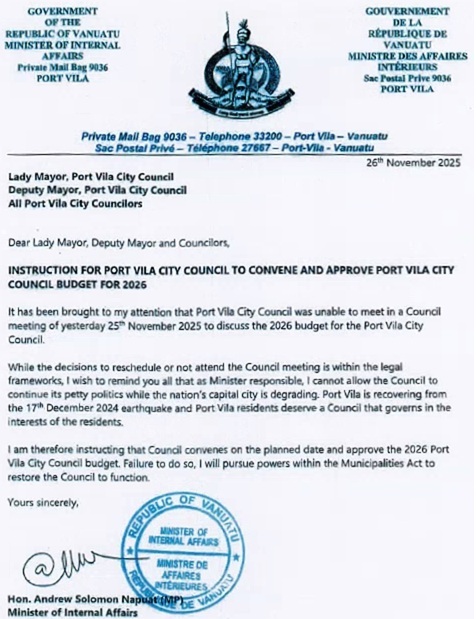
23. Also on 26 November, the Mayor sent a letter to councillors informing them of the date and time for the adjourned meeting. The Mayor concluded her letter with a statement that the meeting would “deliberate on the 2026 Budget”.
24. The Council did meet on 5 December and was quorate. The Mayor said that the meeting should proceed immediately to consider the budget even though it was not the first item on the circulated agenda. Time was then taken up with points of order about the legality of departing from the sequence of business in the agenda. Eventually, without any business (including the budget) having been addressed, the Mayor adjourned the meeting to 15 December for legal advice on the matters raised by the points of order.
25. At the meeting on 15 December, legal opinions were presented to the Council and discussed. Eventually, Councillor Davis Nambaru moved that the agenda be re-arranged so that the budget could be addressed as the first item of business. For reasons which are not clear, this motion was recorded as defeated even though there were four votes in favour, none against and 11 councillors (including all of the present respondents) had abstained from voting. The Mayor then closed the meeting without the meeting having addressed the matters on the agenda. No further meeting was fixed.
26. On 9 January 2026, the Minister appointed three persons (the Investigators) to inquire into six matters concerning the Council, including its compliance with his instruction concerning the approval of the 2026 budget and its “governance and operational performance”.
27. The Investigators provided their report to the Minister on 29 January 2026. It is sufficient for present purposes to record that they reported serious shortcomings in the conduct of the Council’s affairs, including “significant evidence of institutional weakness and governance challenges”, “internal divisions and a lack of consensus”, “[disruptions of] council business leading to frequent quorum issues and adjournments” and that “[g]overnance is severely hindered by persistent internal divisions and a recurring lack of quorum”.
28. Then, without any further communication with the Council or its councillors, the Minister made the order suspending, for a period of five months “unless sooner revoked”, the exercise by the Council of its powers under the Act and appointing Mr Bebe as a Commissioner to exercise those powers.
29. In his sworn statement at the trial, the Minister explained his decision to suspend. He referred to the findings of the Investigators, including debts owing by individual councillors to the Council which were inconsistent with the financial regulatory frameworks and to “significant institutional weaknesses and governance challenges” resulting in “the dysfunctional status” of the Council which in turn impacted on its ability to perform its mandated functions. The Minister referred next to the Council having had a “roll-over” budget for 2025 and said that he had made the decision to suspend. Then in [18], the Minister deposed:
“I further confirm that, pursuant to subsection 61(3) of the Municipalities Act, I considered it expedient to suspend the exercise of the functions of the Council given the confirmed outstanding debts owed by a number of Councillors. These debts demonstrated clear signs of financial mismanagement within the Council. Accordingly, I determined that suspension was necessary to allow for proper internal scrutiny, to ascertain the full extent of these outstanding debts, and to address additional governance and administrative practices which, if left unchecked, could have further undermined the administration and operations of the Council.”
Were the Respondents Entitled to an Opportunity to be Heard?
30. By Ground Two in the notice of appeal, the appellants contend that the Judge should have held that the statutory regime in s.61 did not, in the circumstances of this case, require that the respondents have the opportunity to be heard before the order of suspension was made.
31. In deciding that such an opportunity was required, the Judge referred to a number of previous decisions of this Court, being SLGC v Wells; Minister of Education and Training v Tabi [2023] VUCA 30; and Kuatpen v Lal [2025] VUCA 18, as well as to Lloyd v McMahon [1987] AC 625. In MoET v Tabi, this Court said at [31]:
It is now widely recognised in the field of public administration, and employment that procedural fairness, often referred to as natural justice, requires that a reason and an opportunity to be heard be given before a decision affecting personal rights is made. … Unless a statute specifically provides otherwise procedural fairness now requires that an opportunity be given to be heard. The extent of that requirement will depend on all the circumstances of the case: Michel v President of the Republic and Others [2015] VUCA 14 [25] – [26].
32. The requirement for natural justice to be provided to those who will be affected by the exercise of administrative authority was also discussed in some detail in Kautpen v Lal at [20]-[28]. In both MoET v Tabi and Kautpen v Lal, reference was made to Michel v President of the Republic of Vanuatu [2015] VUCA 14 in which this Court said:
[25] Article 5(1)(d) of the Constitution recognizes that all persons to which the Article applies are entitled as a fundamental right to the "protection of the law". The appellant was entitled to that right which refers to a system of law which incorporates the fundamental rules of natural justice that part and parcel of the common law: Attorney General v. Timakata [1993] VUCA 2; Boulekone v. Timakata [1986] VUSC 13.
[26] However, to accept as we do, that the appellant was entitled to natural justice, or in today's description of the principle, to procedural fairness does not answer the question whether he was entitled to be heard by the President before he was removed from office as chairman and member of the Public Service Commission. The content of natural justice or procedural fairness will depend on all the circumstances of the particular case and will include the nature of the inquiry, the rules or statute under which the decision maker is acting, and the subject matter; Kioa v. West [1985] HCA 81; (1985) 159 CLR 550 at 584 – 5; Durayappah v. Fernando (9167) 2 AC 330 at 349.
33. The appellants did not contend that the principles evident in these authorities were inapplicable. Nor did they contend that it was only the Council, and not the individual councillors, which was entitled to an opportunity to be heard. Rather, they argued that the Minister had proceeded under the éxpediency power in s.61(3) so that provision of an opportunity to be heard was not required in this case. For this purpose, the appellants sought to liken the circumstances of this case to those found in SLGC v Wells.
34. A fundamental difficulty for this submission is that, in the circumstances which existed on 6 February 2026 and for the reasons given above, the expediency power was no longer available to the Minister. Accordingly, the appellants’ submission does not have a sound foundation. But even if that difficulty could be overlooked, the appellants’ submission must still fail.
35. In SLGC v Wells, this Court held that a Minister, who had under s.18L of the Decentralisation Act (a counterpart of s.61(3) in the Municipalities Act), suspended the exercise of the powers of three local government councils, had not been required to give the councils an opportunity to be heard before doing so. The Court regarded the case as being an exception to the general rule that natural justice must be afforded to those who will be affected by a proposed decision, because, at [46]:
(a) the Minister’s decision had been preliminary only, that is to conduct an inquiry and to suspend in the short term;
(b) the legislative scheme (the counterparts of s.61(1) and (2) in the Municipalities Act) would require procedural fairness if, as a result of the inquiry, further suspension or dissolution of the Council was being considered;
(c) requiring procedural fairness at such a preliminary stage would substantially derogate from, and frustrate, the Ministerial power;
(d) the suspensions were a short-term measure for the purpose of facilitating the inquiries; and
(e) the legislative scheme, in particular the use of the term “expedient”, indicated a wide Ministerial discretion and a low level of review “at this stage of the process”.
36. We consider that the Judge was correct in distinguishing SLGC v Wells. Plainly, this is a different case. The situation was no longer preliminary as the Investigators had completed their inquiry and had reported. That being so, it could not be said that the suspension was a short-term measure for the purpose of facilitating the inquiry. Further, in accordance with SLGC v Wells, the process in this case had reached the stage in the legislative scheme in which procedural fairness would be required. That is to say, rather than SLGC v Wells assisting the appellants, it supports the view that the respondents were entitled to an opportunity to be heard before a decision to suspend was made.
37. Further, while paragraph [18] in the Minister’s sworn statement set out above suggests that he had decided that it was expedient to suspend the Council’s powers, the earlier paragraphs indicate that he was relying on the substantive findings of the Investigators. That is to say, that he was intending to proceed to give effect to the Investigators’ conclusions. The proper course in that circumstance was for the Minister to give the Council directions of the kind contemplated by s.61(2) and, in the event of non-compliance to consider suspension of its powers under s.61(3) or, possibly, dissolution under s.61A.
38. Ground Two fails. The Minister was obliged to give the Council and all councillors the opportunity to be heard on the contemplated suspension. That opportunity need not have been long – perhaps a period of seven days to make submissions would have been adequate.
Was an Opportunity to be Heard Provided?
39. By Ground One, the appellants contend that the Minister had in fact given the respondents an adequate opportunity to respond by the terms of his letter of 26 November 2025, set out earlier in these reasons.
40. Again, we consider that the Judge was correct to reject this contention.
41. In the first place, in giving the direction on 26 November 2025, the Minister was not commencing the procedure contemplated by s.61. As previously noted, the first step in that scheme, once the Minister has formed at least one of the opinions listed in s.61(1), is the appointment of a person or persons to inquire into the matters of concern. After the inquiry, the Minister may give a direction to the Council. Other than in the interim cases, the power to suspend does not arise until there has been non-compliance with the direction. There is difficulty in that context in regarding the Minister’s letter as provision of an opportunity to make submissions about the culmination of a course of action which had not even been commenced.
42. Secondly, the Minister’s sworn statement referred to above indicates that he relied on more than one shortcoming in the Council’s discharge of its responsibilities in making the decision to suspend, whereas his letter of 26 November had referred only to the requirement for the budget to be approved in a timely way. For that reason alone, the letter of 26 November was not sufficient notice to the respondents.
43. Thirdly, the action foreshadowed by the Minister in the event of failure by the Council to approve the budget was non-specific (“I will pursue powers within the Municipalities Act to restore the Council to function”). Given the range of powers available to the Minister, this was insufficient notice of opportunity to comment on specific contemplated action.
44. We note that if the Minister had afforded natural justice to the respondents, they would have had the opportunity to point out to him that he was not following the sequence of steps contemplated by s.61.
45. Ground One fails.
The Award of Indemnity Costs
46. The Judge ordered that the appellants pay the respondents’ costs on an indemnity basis. The appellants contend in Ground Four that only party-party costs should have been awarded.
47. This Court noted in Hurley v Law Council of the Republic of Vanuatu [2000] VUCA 10 that normally a successful applicant for judicial review is entitled to party-party costs and not solicitor-client costs. The Judge did not give any reasons for departing from this approach in the present case.
48. While Mr Nalyal for the respondents accepted that he had not made a submission at trial seeking indemnity costs, he nevertheless submitted that this case did fall within the r.15(5)(a) and (d) of the Civil Rules, which identify circumstances in which indemnity costs may be awarded. He was however unable to point to any conduct by the appellants which could even plausibly come within those subrules. Contrary to his submission, the mere fact that the Minister was in error in making the suspension order without providing natural justice to the Council and the councillors does not attract the application of r.15(5)(a) and (d). We note in this respect the finding of the Judge at [64] that the Minister had been acting in good faith when he made the suspension order.
49. For these reasons we uphold Ground Four and will substitute an order that the appellants pay the costs at first instance on a standard party-party basis.
Ground Five
50. The Judge concluded his reasons with a statement of encouragement to the Council to meet as soon as possible to deliberate on an outstanding motion concerning the position of the Mayor and to support the work being undertaken to improve the Council’s operations.
51. By Ground Five, the appellants contend that the Judge should not have made this “order”.
52. Ground Five is misconceived. Appeals lie against orders of Courts and the Judge’s expression of encouragement lacks that character. That this is so is made evident by the Judge’s refusal in the immediately preceding sentence to make a direction on the topic. Accordingly Ground Five fails.
Conclusion, Orders and Costs
53. For these reasons, we dismiss the appeal against the quashing of the suspension order and allow the appeal against the award of indemnity costs.
54. We raised with counsel the appropriateness of the second order made by the Judge, namely, the prohibition on the Minister unlawfully interfering with the current Council. That order had been sought by the respondents in their judicial review application.
55. Our view is that an order in those terms should not have been made. In the first place the order is unnecessary as the Court can expect that the Minister will endeavour to ensure that he acts in accordance with the law. In the second place, the Court should not make orders which may inhibit the proper and lawful acts of the Minister in relation to the Council. In the third place, court orders prohibiting persons from engaging in certain conduct should identify with some specificity the proscribed conduct so that, amongst other things, the subject of the order may know with some confidence what conduct is prohibited and what is not. Accordingly, we will set aside that order.
56. Although quashing the suspension, the Judge did not make an order quashing the appointment of Mr Bebe. An order to that effect is appropriate in order to avoid uncertainty.
57. Mr Nalyal initially submitted that the costs of the appeal should be allowed on an indemnity basis but during the hearing withdrew that submission.
58. We will make an order for lump sum costs on the appeal, taking into account the issues in the appeal on which each of the parties has succeeded.
59. We make the following orders:
(a) the appeal against the order quashing the Minister’s suspension of the exercise of the Council’s powers is dismissed;
(b) the conferral by the Minister of the exercise of the Council’s powers on Mr Bebe is quashed;
(c) the appeal against the mandatory order of prohibition and against the award of indemnity costs is allowed and those orders are set aside;
(d) in place of the order for indemnity costs, the appellants are to pay the respondents’ costs at first instance on a party-party basis;
(e) the appellants are to pay the respondents’ costs of and incidental to the appeal, fixed in the sum of VT50,000;
(f) the stay ordered by the primary Judge on 25 May 2026 is discharged.
DATED at Port Vila this 16th day of June 2026.
BY THE COURT
Hon. Chief Justice, Vincent Lunabek